
Tech in Classrooms: How Much Is Too Much?
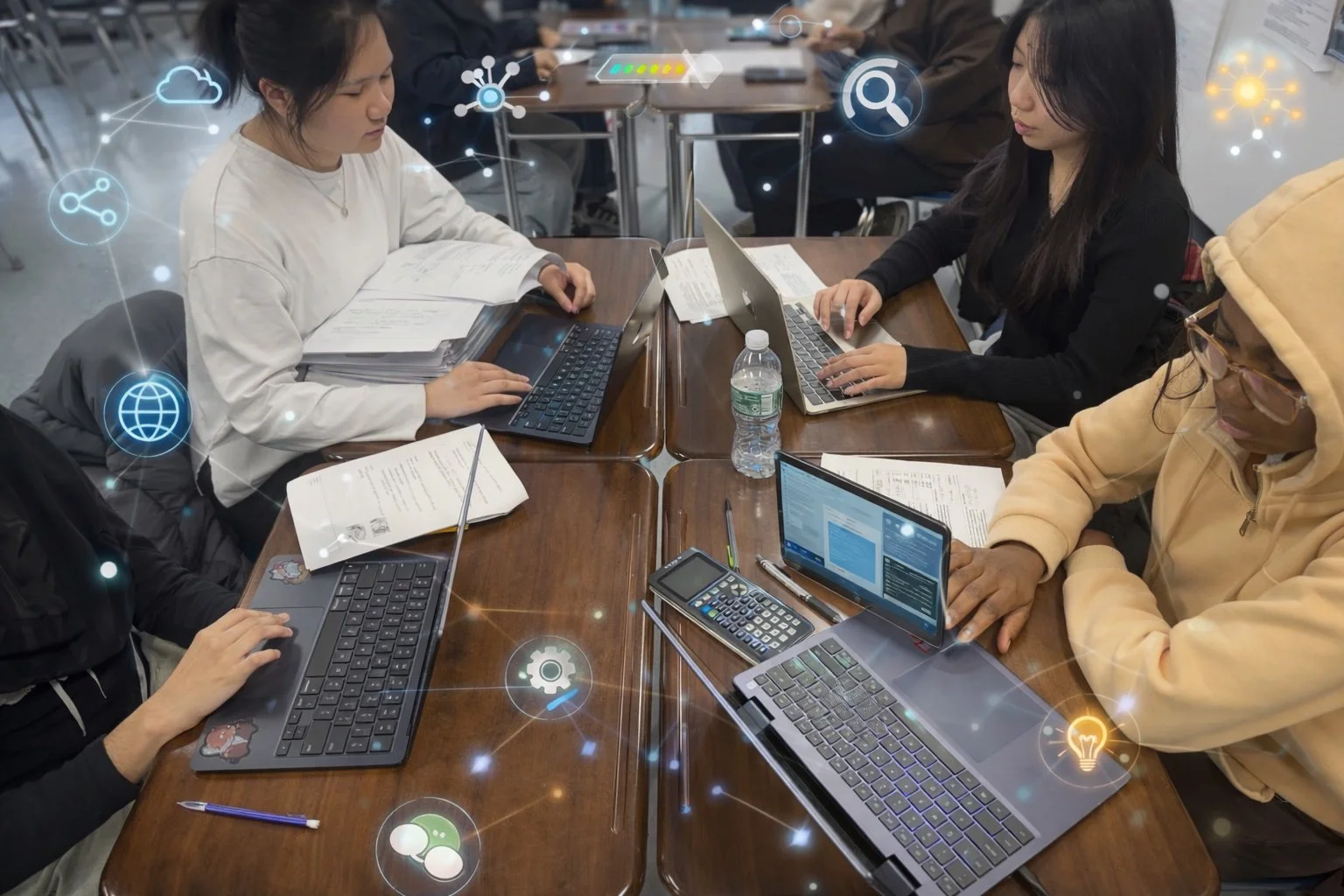
AP Bio students practice long responses on their laptops. Photo: Ani Kakhuashvili
By LAMEYA KABIR
with contributions from Ani Kakuashvili
A student opens their laptop at the start of class. Within seconds, the screen fills with tabs for Google Classroom, a slideshow, a document, maybe a few distractions mixed in. For many at Midwood, this routine feels completely normal. But just a decade ago, it wasn’t.
Classrooms used to run on notebooks, paper handouts, and physical textbooks. Technology was extra, a tool used only occasionally, not something students depended on for nearly every assignment. But today, screens are often at the center of learning, with schools across the country providing laptops and relying on digital platforms for daily instruction.
The shift came with high expectations. Schools believed technology would make learning faster, more engaging, and better suited for the modern world. And there are some signs that it has worked out this way.
“I feel more engaged with classes that use technology,” said Vanessa Larios ’27. “When I use paper, I sometimes just end up doodling and not paying attention.”
Students can collaborate instantly, submit work with a click, and access information within seconds. Teachers can post assignments, give feedback quickly, and communicate with students more efficiently than before.
According to a report from Cambridge International, which surveyed 20,000 students and teachers from 100 countries, technology use continues to grow, as 48% of students reported that they use computers in the classroom, 42% use smartphones, 33% use interactive whiteboards, and 20% use tablets. The U.S. leads the way with 75% of classrooms using computers.
But as technology has become more common, a new question has emerged: Is this actually helping students learn?
Unfortunately, Gen Z has been scoring lower than their parents on many key measures of cognitive development, as a Free Press article by Jared Cooney Horvath points out. Researchers Jean Twenge and Jonathan Haidt say smartphones are a key part of that, but there seems to be an in-school component as well.
According to The New York Times, simply giving students laptops has not consistently improved academic performance, and in some cases, it has made it harder for students to focus. Researchers have found that increased screen use often leads to more distraction rather than better results.
“You open your laptop for work, but then you end up doing other things,” said Chloe Li ‘27. “Sometimes my mind is focused on stuff I see online rather than on schoolwork.”
Research published by The Wall Street Journal suggests students who spend more time on screens in school are also more likely to inefficiently multitask, which can lower their overall understanding and performance.
For teachers, it can be a challenge to stay on top of what every student is doing when each has their own device and needs to be monitored to make sure they’re continuously on task.
Another major concern is how students read and write information. A study from The Guardian found that students understand and remember less when reading on screens compared to when they read on paper, especially with longer or more complex texts. Something about the visual permanence of words physically on a page helps with memory, while the scrolling movement encourages a “skimming” mentality.
Writing, as well as reading, can suffer if it’s primarily done digitally. “I got so used to typing assignments that it gets difficult to write out paragraphs on paper sometimes,” said Noureen Samaha ‘29. It’s also easier to overlook mistakes on a computer when autocorrect is always there to help you.
According to an NPR article by Jonathan Lambert, studies show that children who write by hand learn and recognize concepts better than those who type them out. Handwriting also improves memory and word recall. Adults who take notes by hand during lectures tend to understand the material better than others who type.
“I’ve been taking notes by hand ever since I can remember, and I'm planning to stick to that method since it helps me study better,” said Alexandra Rakhovski ‘26.
Teachers at Midwood are thinking carefully about when technology is most useful. Ms. Laura Gavenda, a social studies teacher, said she primarily uses it “as a reinforcement for content already learned,” rather than as the main way of teaching new material.
“When it adds to the value of the lesson, that’s when it’s appropriate,” she said.
At the same time, not everyone believes technology is a problem. Many students and teachers say it still plays an important role in learning.
“Technology made it easier for me to learn when all of our assignments were moved to Google Classroom,” said Elham Mahmood ‘27. “It created a hub where I could find all the work and resources I needed from my teachers in one place, which was really convenient.”
The Drexel University School of Education argues that tech also helps students with different learning styles, explaining that not all students learn the same way or the same speed. Computers offer another tool for teachers to differentiate instruction. And AI has the potential to personalize learning even more.
“I used AI to generate questions similar to those of the AP tests and was able to have a plethora of questions at my command to study for, personalized to my weakness and strengths,” said Ricardo Torres ‘26.
In some subjects, technology isn’t just helpful — it’s essential.
“I think technology is at the core of any instruction that you're doing in a computer science classroom,” said Ms. Janet Gillespie, an AP Computer Science Principles teacher. “We're teaching students how to be digitally literate and understand technology beyond their cell phones.”
Still, even supporters of educational tech admit that there are downsides.
“Though it’s often obvious when something has been copied or generated, there are other times when students use technology unsupervised and it’s hard to tell if the work is really theirs,” said Mr. Luis Cuevas, a Spanish teacher.
“[Tech] can make learning more engaging and give students access to helpful resources, but it can also be distracting and sometimes replace basic skills if overused,” said Ms. Cynthia Ly, an AP Biology teacher.
Across the country, some schools are beginning to rethink their approach. A growing number are reducing screen time, bringing back paper assignments, or limiting device use during class. Many of the advantages of technology – for research, study, or communication – take place outside of the 45 minute class period. Individually isolating students on laptops for period after period may be a mistake. The goal for reformers isn’t necessarily to remove technology, but to find a better balance.
“I have my classes use laptops when it feels like we need a change of pace,” said Mr. Cuevas. “It’s good to switch things up, but it shouldn’t replace everything.”
The research shows that schools may not have found that balance yet. While technology has clear benefits, too much of it can hurt focus, comprehension, and deeper learning.
Overall, the evidence suggests that schools are likely using devices too much. Reading scores and performance on national tests in all subjects have been declining in recent years as tech use has gone up. There are very few scientific studies that show a net benefit for widespread tech use, but several that show significant downsides. Tech-free private schools have been attracting wealthier families, as well as (ironically) many parents who work in the tech industry.
In short, schools should not rely completely on technology, but instead use it in moderation so that students can reap the benefits without experiencing the negative effects. The challenge moving forward is figuring out how to use it more intentionally, because in today’s classrooms, the question isn’t whether technology belongs, it’s how much is too much.