
Science Olympiad Takes on Bugs, Labs, Engineering and More
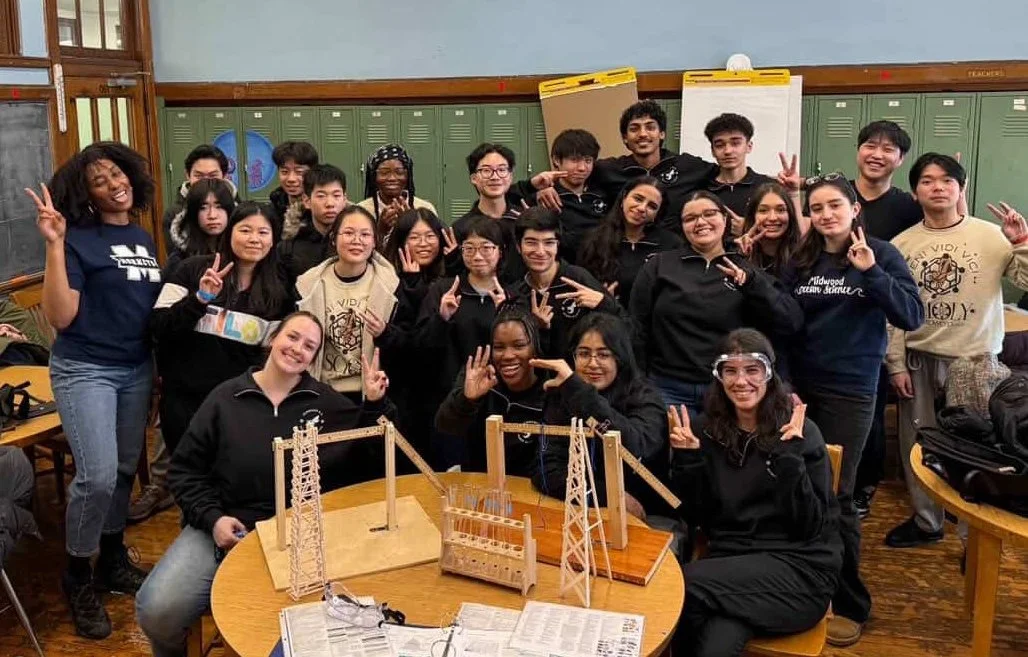
The team’s specialized groups focus on engineering challenges, labs, and written tests in a variety of subjects. Photo: Midwood Science Olympiad Team
By NOUSHIN ISLAM
Since the beginning of their preparations in late autumn, the Science Olympiad Team has refined their skills for various regional showdowns, including a major competition on January 31 at Grover Cleveland High School. The competition saw Midwood face off against top-tier specialized schools and local rivals like New Utrecht, Goldstein, Fort Hamilton, and Susan E. Wagner.
At the helm of the operation are dedicated leaders like Asha Archer ‘27 and Daoud Mirza ‘26, who guide the team through a rigorous schedule. "Science Olympiad is an awesome experience as it teaches you teamwork and collaboration,” Mirza said.
Success in the club requires more than just scientific knowledge; it demands intense time management and dedication from every member, with much of the work required to prepare for competitions happening outside of regular club gatherings.
A typical meeting starts with a briefing on important dates before members break off into groups of 2-3 to tackle specific events featuring different types of science. Mary Ogonwale, a senior, took part in an entomology event (the study of bugs) and said, “It was really, really fun. We had a binder full of a whole bunch of insects – I think it was like 80 – and we had to identify them based on an image, giving the family, the order, their behaviors, and stuff like that.”
The competitions are versatile, featuring engineering challenges, labs for hands-on experiments, and written tests with complex, college-level content. Because members always work in pairs or trios, communication is the team’s most valuable tool during these study sessions.
To prepare for the January competition, juniors Angel Wu and Umayma Shakoor, who are both in their first year of Science Olympiad, spent weeks mastering the “Write It, Do It” event. In this challenge, Partner A enters a room to view a hidden object and must write technical instructions on how to replicate it. These instructions are then handed to Partner B, who must reconstruct the object from scratch using only those notes. Wu noted that while the work was intense, the collaboration and study sessions at the public library made the experience memorable.
The build events are often the most visually impressive, requiring students to construct complex machines from scratch. This year, the team worked on projects including boomilevers, which are crane-like wooden structures designed to support significant weight—often up to 15 kg—while attached to a vertical wall. Shakoor, who built one of these structures, noted the precision required to keep the lightweight wood from snapping under the heavy load.
The team also tackled the Machines Division C event, where Benjamin Avez ‘27 constructed a device utilizing different classes of levers. The machine functions like a balance beam scale, allowing students to determine the weight ratios of unknown masses by moving them along suspended rulers until the device is perfectly balanced.
"The challenges were getting it to properly balance and function, since things like lack of friction and weight inconsistencies skewed results," Avez said. He was able to use a counterweight and apply twine to increase friction, preventing the weights from sliding.
Students also perform chemistry and physics labs with live experiments based on provided instructions. Participants in these events spent their preparation time mastering kinetics and stoichiometry. These chemistry units are typically found in rigorous AP-level courses rather than standard high school classes.
Other members focused on anatomy and physiology, centering on the complex systems of the human body. This event functions primarily as a comprehensive exam that requires months of study to master. Many students prep on their own time and get help from other members.
Wu, who often spends time in the library studying, said that the lab events were "like a game” because even though “the workload is intense, members dive deep and help teach the others.” She adds that even study-heavy events like Codebusters were worth the effort, noting that the team’s "collective struggle of learning the different types of ciphers" was a highlight of the season.
So if you’re a science fanatic looking for a variety of ways to test your knowledge and gain specialization in a competitive but supportive atmosphere, consider joining the Science Olympiad Team next year. Just be ready to hit the books!