
One Semester In, How Are Students and Teachers Feeling About the Cell Phone Ban?
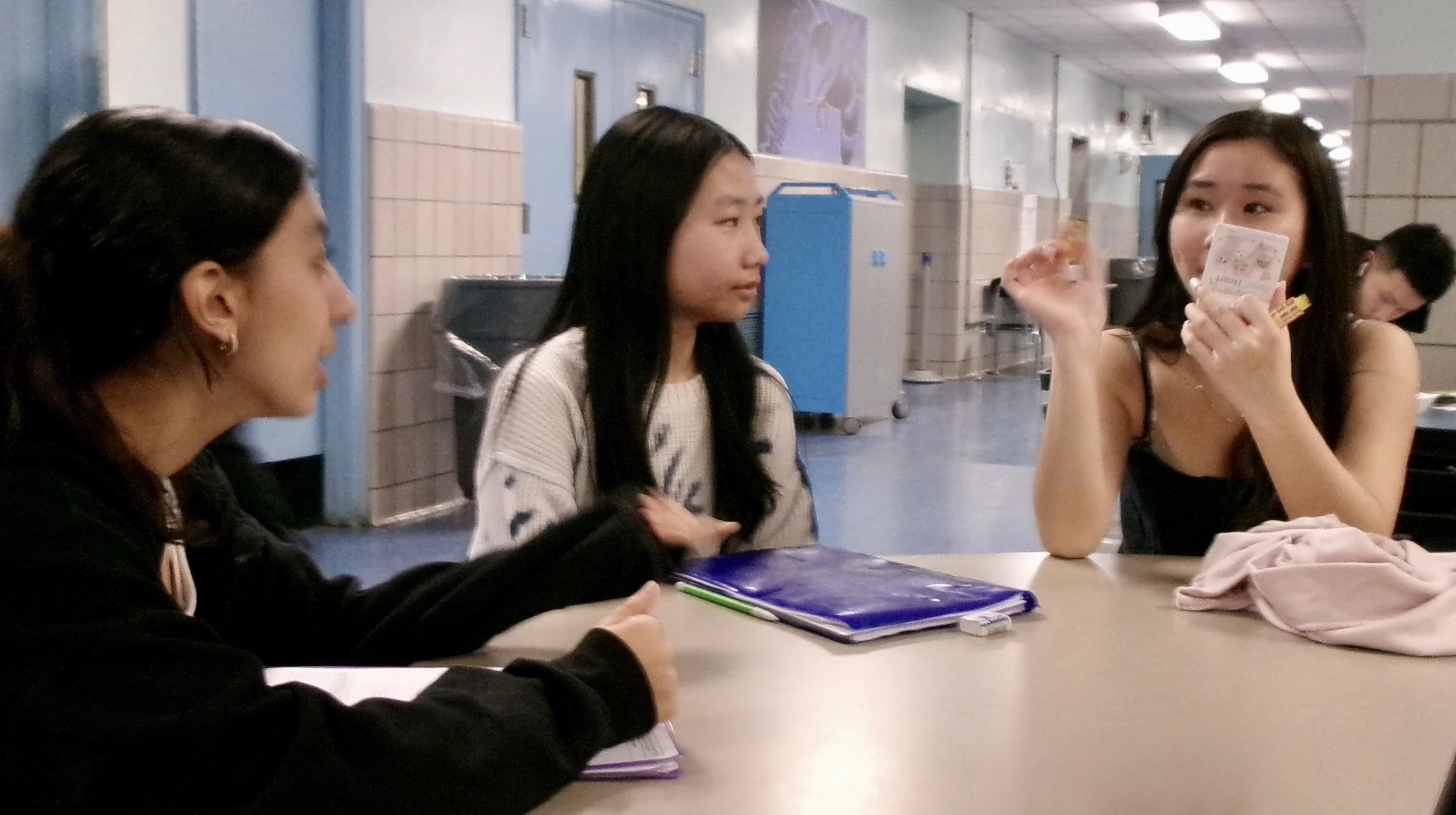
Without their phones to entertain them, students engage in conversation with peers during lunch. Photo: Amelia Crawford
By ERISA MANI, AMELIA CRAWFORD, and ANI KAKHUASHVILI
Walking through the halls, you’re unsure of where to look. Up? Down? At the person next to you? The empty feeling in your hand weighs you down.
Phones used to be a constant confidant during the school day but with the device ban now in place for a full semester, students and staff alike have had to adjust to fewer screens and new routines. There have been some bumps in the road, but also evidence that it was about time we hung up on distractions.
Across New York State, schools are now required to have a bell-to-bell ban of smartphones and other internet-enabled personal devices, to improve mental health, eliminate classroom distractions, and encourage social interaction. So how are our Hornets holding up?
“I find myself lost in thought more often, but regardless, I think not having my phone helped me stay more focused,” said senior Najif Ahamed. He says he suffered from social anxiety, and being able to easily hide behind his phone only made it worse. Now, not having the phone forces him to face his fear head-on.
Of course, having to keep your phone stored in a velcro faraday pouch all day can certainly be inconvenient at times. Ahamed’s grades haven’t changed, but “my ability to quickly look things up to solidify my knowledge on class material is gone,” he said.
The teachers we spoke to said the phone ban is mostly beneficial. They say that students are communicating more, discussing class-related topics instead of scrolling through Instagram reels, and that they’re overall more on-task.
Ms. Cynthia Ly, an AP Biology teacher, says that compared to last year, her students are noticeably less distracted. “Student engagement has increased, and discussions feel more genuine,” she said. Ms. Ly mentions that socially, students are interacting more and strengthening their communication skills.
Mr. Joseph Peters, an AP U.S. History teacher, agreed. “Kids are more willing to talk to me and each other,” he said. “As a teacher, I now have much more control over the way technology is used in my classroom.”
Ms. Mamie Chu, a dean and mathematics teacher, says that with the cell phone policy there have been less conflicts, including on social media. “I think previously, students didn't even realize that they were so addicted to their phones,” she said. “It was almost second nature to flip it over and check their messages. I've noticed less bathroom usage from my students as well.” However, phones were a great way of collecting data quickly in the classroom, she said, so she misses that element.
Mr. Daniel Madden, a physics teacher, said phones can come in handy for a class like physics because if a student forgets their calculator, their device can serve as a good impromptu one for the day.
Art teacher Ms. Lauren Rocco used to let her students use their phones to search for references, which she now has to print out. However, students do seem to be more focused on class materials without their devices at hand. Before the ban, “students would sometimes pretend to use [their phone] for something class-related and then change the tab to something else,” she said.
UNESCO reports that technology can support learning when used appropriately, but overuse, especially of smartphones, can disrupt classroom learning. Even with a cell phone simply nearby, it can take up to 20 minutes for a student to fully refocus after a distraction. Research also found that removing smartphones from schools in countries such as Belgium, Spain, and the United Kingdom improved learning outcomes, particularly for lower performing students.
As important as learning is, mental health concerns have been just as much a part of the philosophy behind the ban. Psychologists Jonathan Haidt and Jean M. Twenge have shown that teenage loneliness, depression, self-harm, and suicide rates have been increasing since more teens started using smartphones and social media. Rates of teen depression have doubled since social media went mainstream around 2012.
So did we get the improvement in social interaction policymakers were hoping for? Senior Iftia Azem doesn’t see it. “The only goal the phone policy has accomplished is to make school less distracting, as students are truly listening to their teachers now that they don’t have access to their phones,” Azem said.
Junior Shahd Elrashidi agreed, saying that students are more focused during class this year compared to last year. “I noticed that without phones, they’re forced to pay attention,” she said. In regards to social engagement, she agrees with Azem that things seem the same.
Students miss many of the practical uses of their devices, such as being able to easily contact family members throughout the day, and keeping track of their lives. Sophomore Sophia Aparicio said, “I can’t put important dates in my phone, and I can’t take pictures or videos of important moments in my school life.”
School administration expected the adjustment to be difficult. “It’s like an appendage on your body that you’re always checking, you’re always thinking about it,” said Principal Dr. Robert Quinlan. The ban seeks to gradually crack that thought process.
Maintaining the ban can be a hassle for staff, requiring constant vigilance. “Students have recently gotten past the ‘honeymoon’ phase of this policy and are trying harder to find ways to sneak in some phone use,” Mr. Peters said.
But in general, teachers like the policy, and about half of students in a recent Argus poll (see below) admitted that it might be the right choice.
Milani Harrington ‘29 said she has had a better year, both socially and academically. Her grades are in the 90s, the highest they’ve ever been, compared to middle school, where “I was getting 80s and some 70s here and there,” she said. “It wasn’t the best I could do.”
All in all, Dr. Quinlan believes that it’s too early to tell if the ban will accomplish all its goals. In the short term however, it has definitely reduced phone usage in the classroom. What’s left is to see how the policy will play out in the future, and he sounded optimistic about that.
“At Midwood, we really do have a beautiful, diverse, amazing community of students who want to do great things, clubs, and activities,” said Dr. Quinlan. “I always knew going into it that we had the student body to get the job done.”
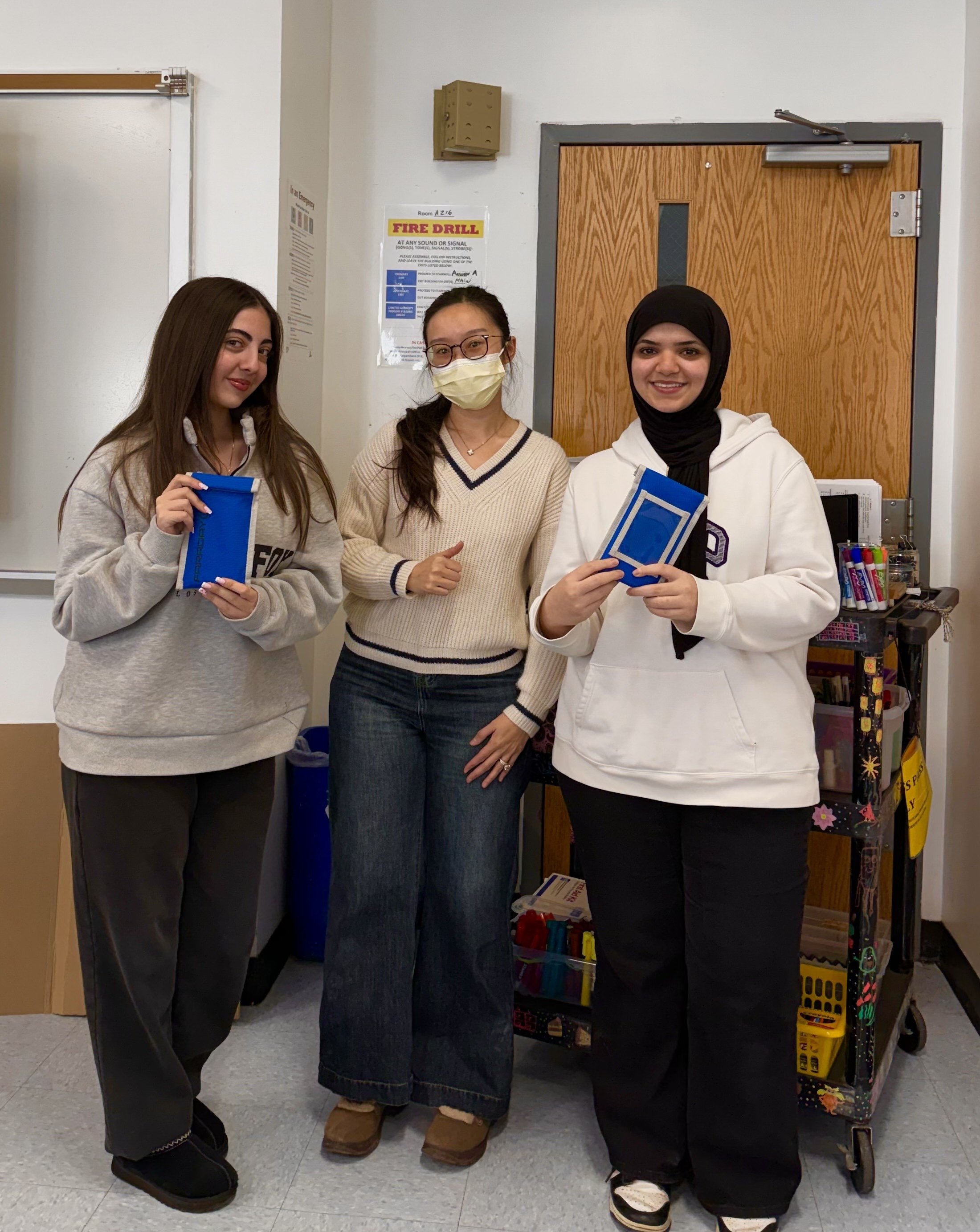
Ms. Cynthia Ly and her AP Biology students present their phone pouches. Photo: Ani Kakhuashvili
Argus Poll: Students Have Gripes About Cell Phone Ban, But Many Acknowledge Its Benefits
At the beginning of the 2025-2026 school year, in compliance with New York State law, Midwood banned the use of cell phones and other personal internet-connected devices throughout the school day. Now that students have had a semester to get used to the policy, we were curious to see how it was going, so in February we conducted a poll of over 100 Hornets to get their thoughts.
Some states that have already tried device bans have said they’ve seen better focus and an increase in academic performance and social interaction. Our respondents were slightly positive on this: 54% agreed that "students seem more focused and less distracted in class this year” and that “in school, students are being more social (e.g., talking face-to-face more)," while 46% said they saw no difference.
It’s unsurprising that students are personally opposed to the new rules. However, more of them than might be expected seem to feel that the benefits outweigh the annoyances: 44% admitted that "it's good that students can't check their phones during class like they used to" and 49% agreed with the statement "Even though it isn't perfect, things are better overall when cell phones aren't allowed in school."
There is one thing most Hornets would change if they had the power. The ban extends throughout the school day to encourage social interaction outside of class, but 80% of our respondents said that “students should be able to use their devices in school when they are at lunch or on their free period."
That’s not just because of TikTok withdrawals. About half of our respondents said that the device ban made it harder for them to complete class assignments, and 86% said “I have not been able to send or receive important messages to / from a family member or employer because of the school's electronic device policy” (though school computers and flip phones could be used for these purposes if necessary).
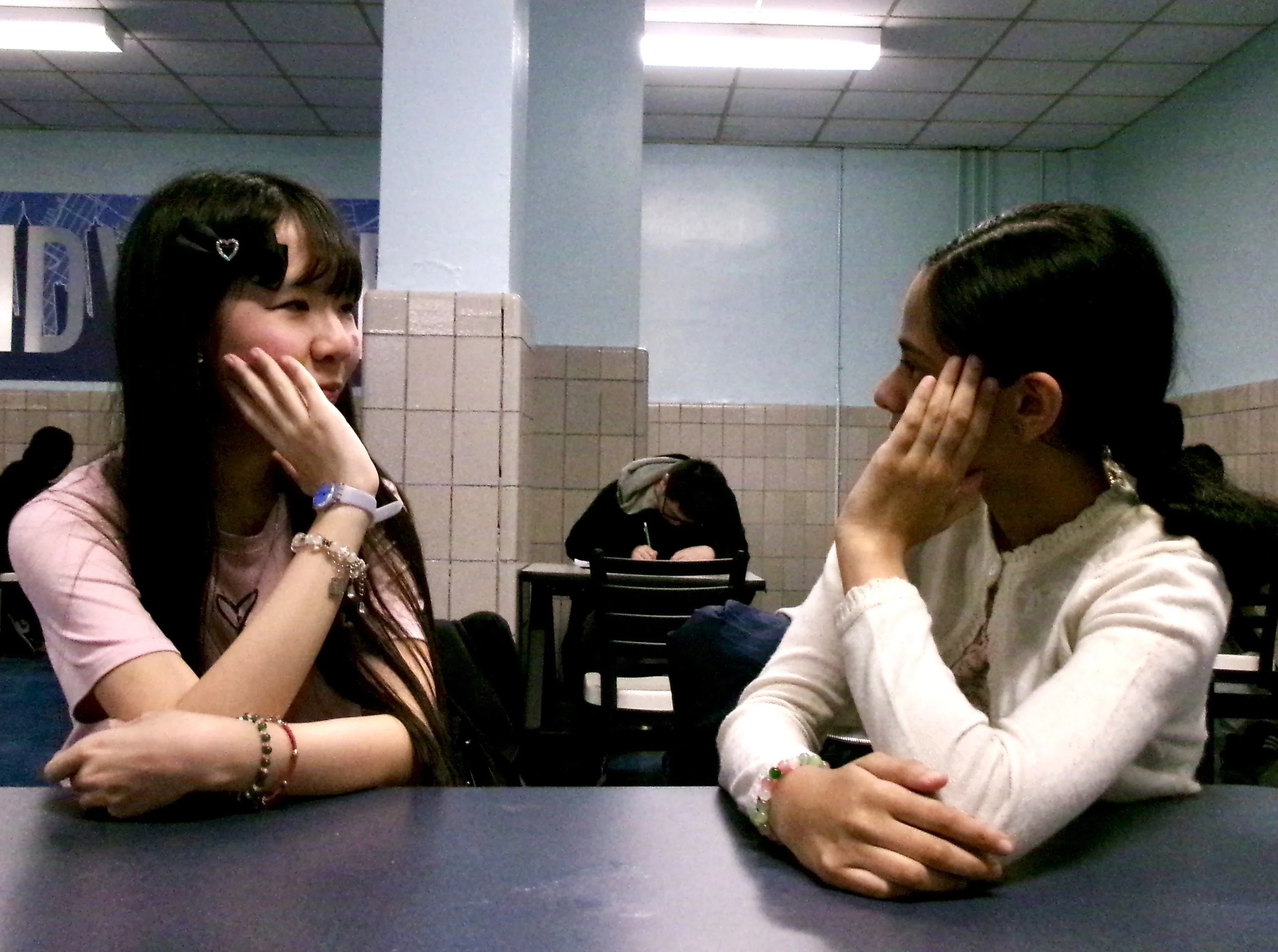
The cafeteria now features more face-to-face interactions. Others use their free time to get work done. Photo: Amelia Crawford