
Is the SAT Easier Than It Used to Be? We Did An Experiment to Find Out.
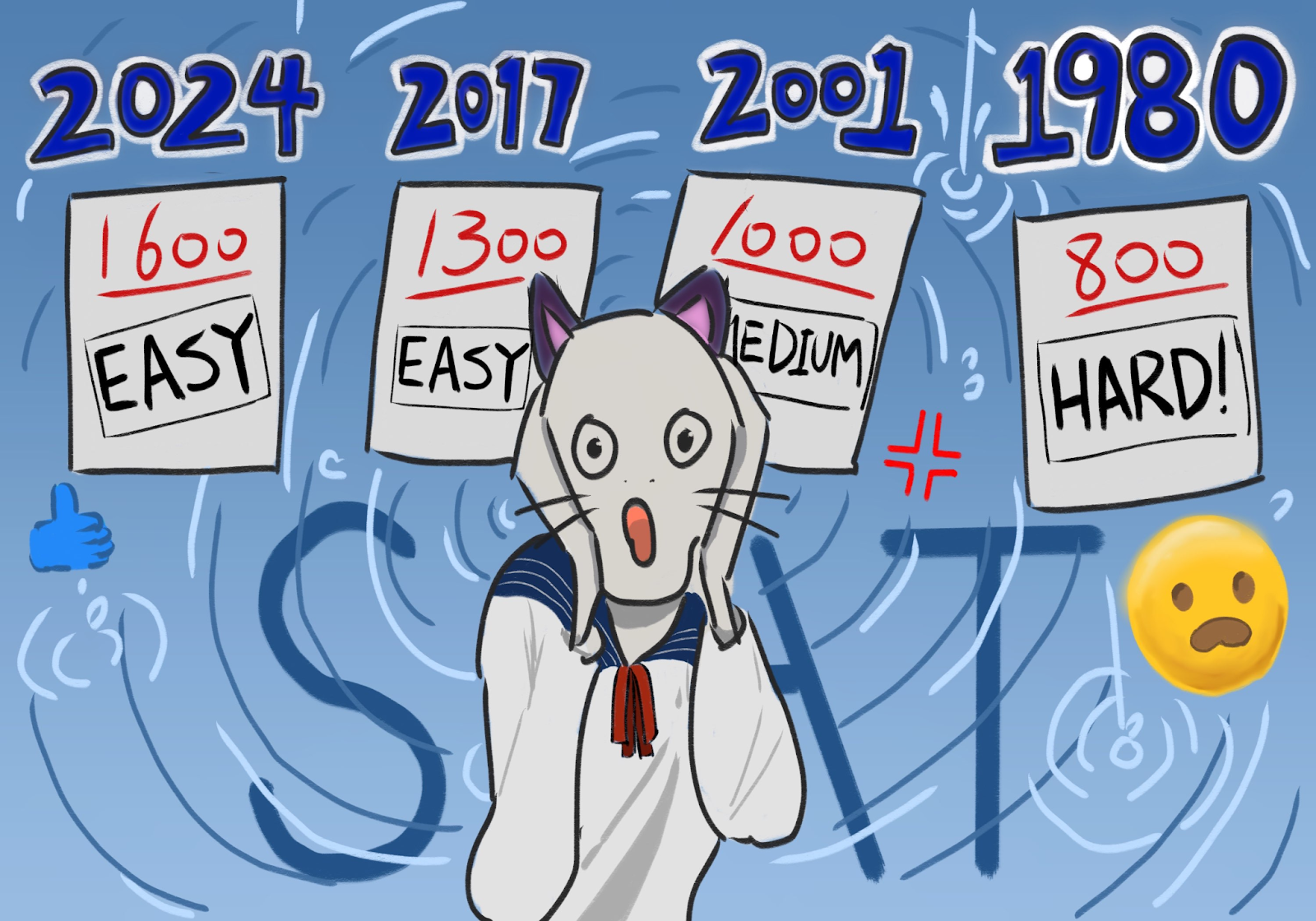
We wouldn’t wish the 1985 SAT on our worst enemy. Art: Luyi Zhang and Luchu Zhang
By LAMEYA KABIR and HUI SHAN ZHANG
with contributions from Luyi Zhang
Every generation of students seems to hear the same claim: the SAT used to be harder. Parents and older siblings often reminisce about filling in bubbles with a No. 2 pencil, having no calculators, and losing points for guessing.
Today, the SAT looks very different. Students take the test on a laptop or tablet using the College Board’s Bluebook app. There’s a built-in calculator, simpler directions, and a more modern layout. But does that mean the questions themselves are easier than they were in the past?
To find out, we took four SATs from different time periods. The SATs we completed were from 1985, 2001, 2017, and 2025. We took an up-to-date practice test on College Board’s Bluebook app first to get a baseline score. The three of us together averaged a 1250, putting us in the top 25% of test-takers, above the nationwide mean of 1029.
Each test we took was timed carefully, and we followed the rules that applied during each era. Among those rules were calculator restrictions for older exams and penalties for incorrect answers.
The experience of taking each test felt very different. Not only did the format change over time, but the type of questions and skills being tested also shifted.
The 1985 SAT felt the most intense from the very beginning. One of the biggest differences was the scoring system. For most multiple-choice questions, getting an answer wrong meant losing a quarter of a point. This made guessing risky and stressful, since answering incorrectly could lower your score more than leaving it blank. There were also five multiple choice options instead of four.
On this exam, the three of us averaged a 900, which was 350 points lower than our 2025 scores and a bit lower than the nationwide mean at the time of 1009.
The 1985 test’s reading and verbal sections were demanding. Vocabulary played a huge role, and many questions relied on words that are rarely taught in schools today, like "torpor," "extol," and "upbraid.” We had to select a word that was the opposite of a given word without context, or select a pair of words that had a similar relationship to each other as another pair of words. For example, “emaciated:nourishment” would be correctly connected to “flabby:exercise.” This area required a strong vocabulary bank to score well.
Reading passages were also long and dense, usually at least three paragraphs, often focusing on abstract or academic topics, requiring strong reading stamina with a high level of concentration.
For the math section, we encountered questions we’d never seen before. One involving ratios and fractions showed a highway system with six different lettered roads with directional arrows, asking what the ratio was of traffic on highway H to that on highway R. Besides the difficult concepts, having no calculator made the section extra challenging, and since questions towards the end were especially wordy, it consumed more time than expected.
The 2001 SAT showed some changes, but it was still far from easy. Like the 1985 version, it continued to use guessing penalties, which meant students still had to be cautious about answering questions that they weren’t confident in.
Calculators were now allowed, which aided in the math section, but the problems were still complex. Many questions required strong algebra skills and careful reasoning.
The reading section focused more on comprehension this time than pure vocabulary, but advanced language use was still common. Passages were long and required close attention to detail. Many questions asked about tone, purpose, or what was implied rather than direct comprehension.
On this exam, we three averaged a 1020, higher than our 1985 scores, and even with the nationwide mean, but still more than 200 points lower than what we got on the modern test. So while the test was still difficult, it was slightly more manageable.
By 2017, the SAT had undergone significant changes. Among them was the removal of the guessing penalty. Students were no longer getting points taken off for wrong answers, so they could attempt every question without fear of losing points. Also, there were now four multiple choice options instead of five, making the answering process a little faster and easier, and increasing a student’s chance of guessing right.
The math section focused more on real-world scenarios. Calculators were allowed on one of the sections, and many questions involved interpreting graphs and tables instead of performing long calculations.
The reading section also looked different. Instead of testing vocabulary as much and in isolation, words were tested within the context of passages. This meant students no longer needed to memorize so many definitions. They also removed the “opposites” and “related-pair” questions. However, this test still had several long passages (500-700 words).
On the 2017 SAT, we averaged a 1270, which was roughly the same as our 2025 average, and better than the nationwide mean of 1060. The increase reflects a format that matches more closely with what students are taught in modern classrooms.
Looking at all three exams together, the biggest difference wasn’t just difficulty but also design. Older SATs placed heavy emphasis on vocabulary, reading stamina, and math conceptualization and computation. The 2025 test has gotten rid of long passages for the reading section – now most are only 25-150 words, or about one paragraph, and students have access to a powerful online Desmos graphing calculator for all math problems. Like in 2017, there are fewer multiple choice options and no guessing penalties.
Based on our experience of taking the SATs across many decades, it’s clear that the test has become more student-friendly. Today’s SAT still requires a strong reading ability, solid math knowledge, and good time management skills, but the stress level is lower, and the rules are more forgiving. Whether a student from the 1980s or 2000s could perform just as well on today’s SAT is up for debate, but it’s safe to say that we prefer our version to the ones teens endured decades years ago.
What happens when you give THE 1985 SAT to a modern classroom?
To see for sure if the SAT really used to be harder, we drafted 17 more students to repeat this experiment. They completed the English portion of an SAT from 1985 and the English portion from a recent official practice test provided by College Board on the Bluebook app and showed their scores to us. Both tests had a maximum possible score of 800, and the average student of both eras scored roughly a 500.
In the end, it was unanimous: Every single student in our group of 17 said the 1985 test was harder. The group’s average English score on the 2025 SAT was 560, while their average on the 1985 version was 380. This means that the group performed slightly above a typical modern day student, but significantly below the average of a high school senior from forty years ago – though it should be mentioned that fewer students took the SAT and went on to attend college in the 1980s. Whether this drop-off is because schools’ approaches have changed or because the test simply got easier (or both), remains uncertain.
Here’s what our test-takers had to say:
“The vocabulary on the old SAT is very specific, often words that are not used on the daily. Especially difficult was the reading comprehension questions – the passages were often long and required annotations to understand the main idea. The multiple choice options were similarly worded to each other, making it harder to choose the right answer.”
“Some vocabulary in the old test isn't commonly used, like ‘zany’ or ‘decorousness.’ In one of the sections, you're required to know the definitions of all the vocabulary to identify the one pair that shows the most similar relationship. These questions were difficult. The reading passages were also longer and more comprehensive compared to the modern ones.”
“The old SAT’s reading-heavy portion had more than four questions for one long passage, compared to today's SAT with shorter passages and one question each. Overall, the 1985 test had a specific format that required intentional studying. Students can have general knowledge and score a 1300 on the modern SAT; the older one is much harder.”
“On the old SAT, there were so many words I didn’t know, and it made my brain hurt. I found myself having to reread the questions and multiple choice options way too many times, and I had to stop and say ‘what?’ for almost every question. However, the reading comprehension questions on the old SAT were easier than the modern ones to me because the answers are right in the text and you don’t need to make inferences.”
“The 1985 SAT had confusing vocabulary I don't use every day. I felt like I had to reread the questions over and over again just to understand them. The passages were also difficult to get through because they were filled with old-fashioned wording. That made it more stressful since I was spending a lot of time just trying to understand what the author/question was saying instead of actually answering the question.”
“I'm glad College Board decided to change the test. If they hadn’t then I might've given up and passed out.”