
Virtual Enterprise Gives Students a Taste of the Future in Business and Tech
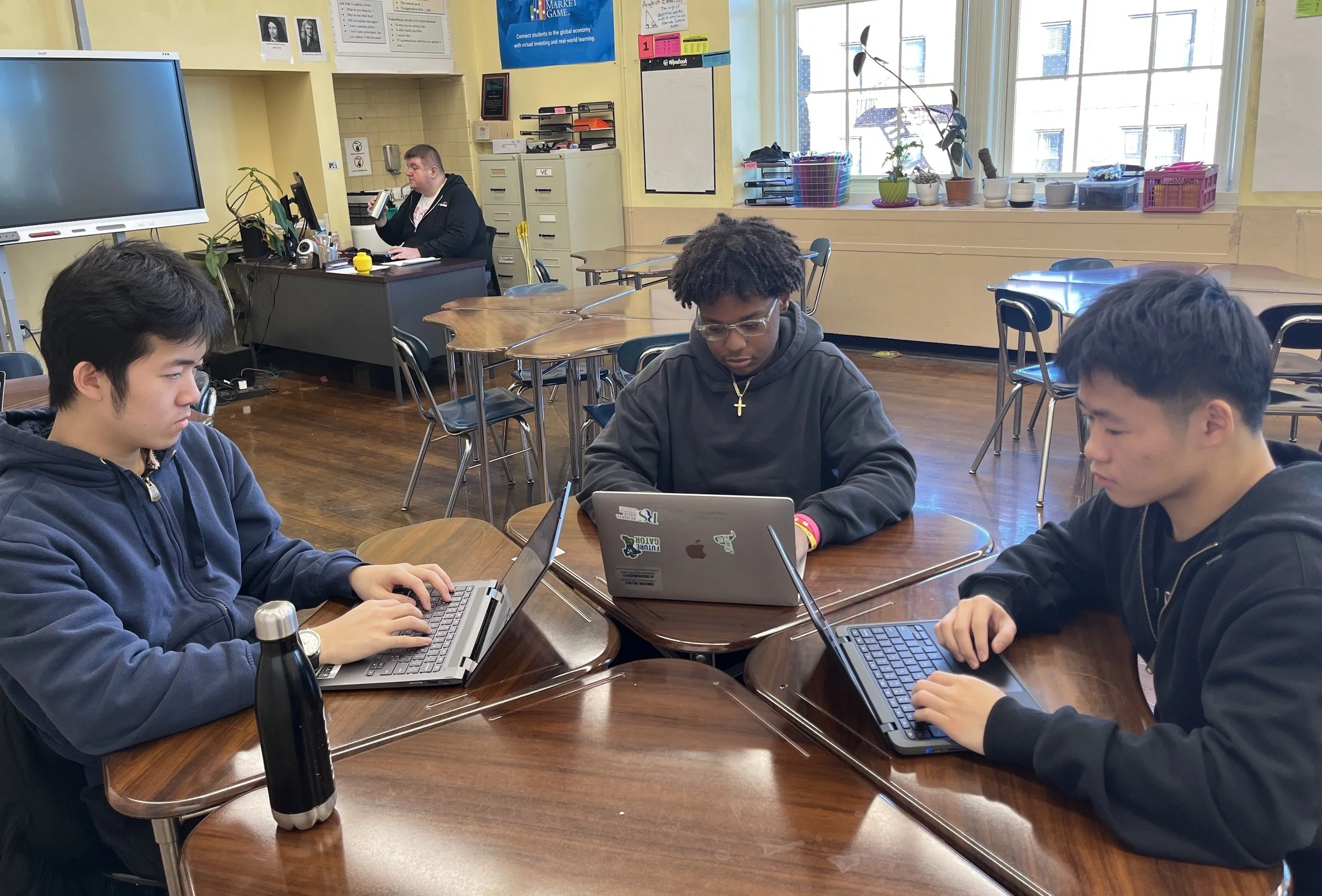
Senior VE students work on their business product. Photo: Omar Gonzalez
By OMAR GONZALEZ and HUI SHAN ZHANG
Imagine pitching a business idea you and your team have spent countless hours building, in a room thick with the smell of coffee and pressure so intense that you feel it crawling through your skin and weakening your legs. Bright lights shine down on you, mixing hope and fear into one sharp feeling in your chest. You need to present in front of a group of cold-blooded, sharp-eyed judges, and do so in a confident and firm manner. Your average Joe will pass out, but to Midwood's Virtual Enterprise students, this is nothing more than a casual Saturday evening.
The Virtual Enterprise course, taught by Mr. Jakub Karpieszuk, exposes students to real-world business, marketing, financial, and entrepreneurial experiences as they build and manage their own companies.
Mr. Karpieszuk proposed the idea because of his love for business and his desire to enlighten future generations on its concepts. “I worked in finance for ten years before I was a teacher,” he said. “Business was always my passion.”
Each class is split up into two companies. One example is Flomingo, a flavoring pod company that also sells carbonated bottles. Its purpose is to make healthy energy drinks with a diverse flavor range.
These companies enter competitions like the one on February 13 at St. Francis College, where various schools pitched their ideas to the judges. There were five rooms and nine to ten firms per room. Each team had ten minutes to introduce their company and talk about their product, marketing plans, and goals. The top two firms from every room advanced to qualifying rounds to compete on the national level.
“We didn’t pass that round, but it was a really cool experience because we got to meet a bunch of other firms and connect with them,” said Chief Technology Officer Tina Cao ‘26. “It was also a really big learning experience to see how our competitors were doing and how we could improve for next year.”
The students say they enjoy the class because it’s self-led and fuels their interest in business, even though a big time commitment is required.
“I enjoy the success that we make as a company and the progress we achieve,” said Cao. “Consistency and time management can be a struggle, though.”
“I like math classes, but not math, so finance was the way to go,” said Emma Hittleman ‘26. “Everything here is self-led, and you have to hold yourself accountable for what's going on.”
“I want to work in business, and this class lets me experience it before going into the real world,” said Eric Luke ‘26.
A lot of responsibility falls on the chief executive officers (CEOs) and chief operating officers (COOs), as they are the ones in charge of the operations, having to make sure everything goes smoothly. Under them are five departments: sales, marketing, human resources, finance, and technology.
“It's stressful as people are always looking up to you for guidance,” said CEO Jefferson Xu ‘26.
“As part of the marketing team, I work on social media posts, advertising campaigns, and branding ideas to help promote our company,” said Anastasiia Savchyn ‘26. “Every day feels like working at a real company since we hold meetings, collaborate on projects, and solve problems together.”
Early in the semester, students give an “elevator pitch,” where they have 60 seconds to go up in front of everyone and attempt to “sell themselves,” explaining why they would be a good asset to the company.
The positions of CEO and COO are based on their elevator pitches. Mr. Karpieszuk invites them to an interview, and if they pass, they are given an executive role. Those who don’t pass can interview individually within the department of their choosing and become a management associate.
During the elevator pitch, “I was a little nervous because I was speaking in front of everyone and talking about myself, but it wasn’t that bad,” said Cao.
Over its three years of existence, the program has grown in popularity. In the first year, there was just one class; now there are two and a waitlist. It’s a great way to experience the hard work and ups-and-downs of entrepreneurship, taking some wins and some losses without risking your savings.
“One major thing I want my students to take away from this class is that it's okay to fail,” said Mr. Karpieszuk. “A valuable lesson of life is that we all struggle and it’s okay to fail, but you must keep going.”