
Robotics Teams Take Home 'Think,' 'Innovate,' and 'Control' Awards at Second Qualifier
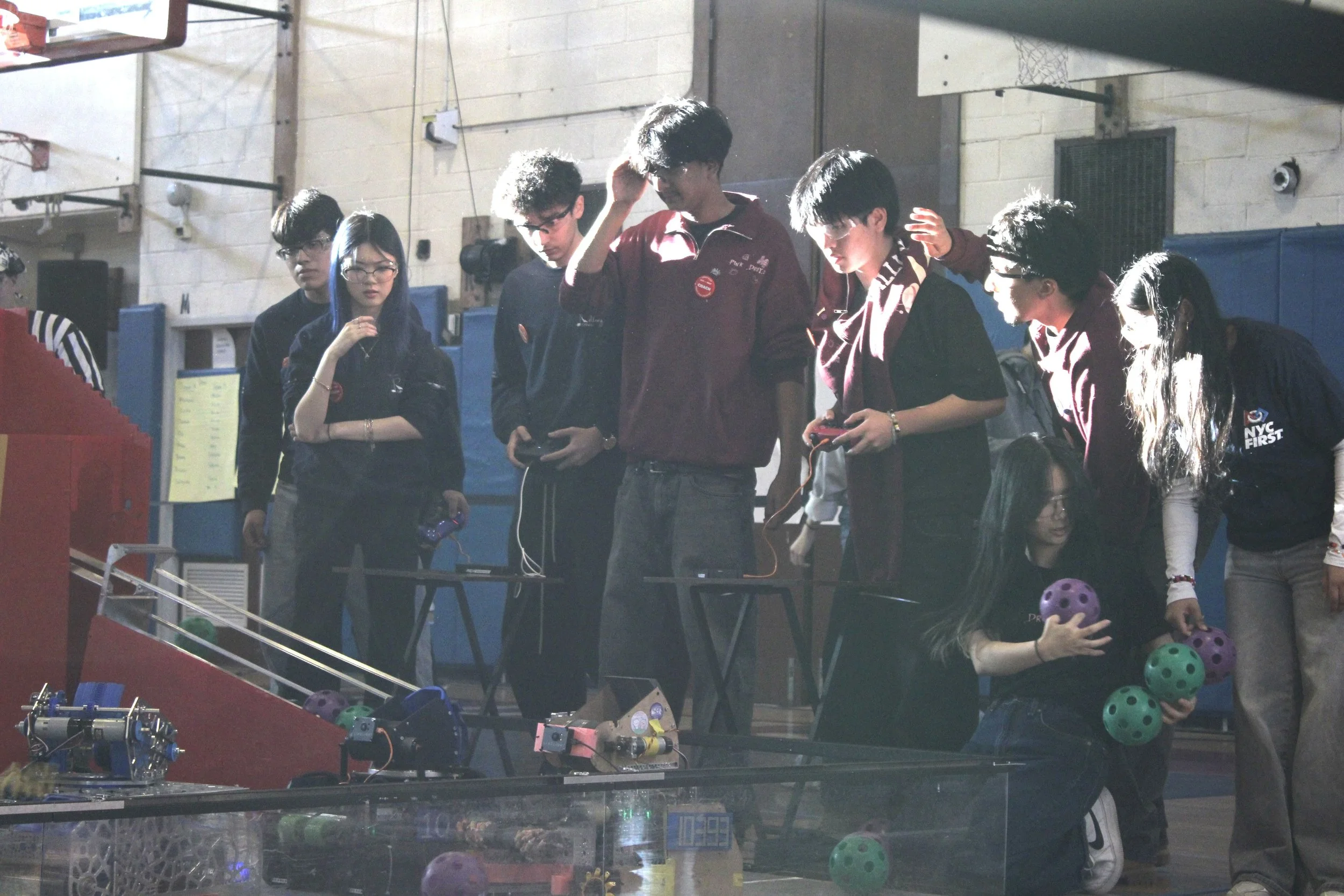
Pink Droid and the Rolling Drones team up to collect artifacts during the tele-op period of March 1’s superqualifier. Photo: Ms. Lisa Ali
By JAYDEN COURTOIS
What began as a season weighed down early on by inconsistency and imperfect code ended in a breakthrough moment defined by resilience and ingenuity. When the second to last award of the second qualifier was announced on January 18 at Francis Lewis High School, two of our robotics teams realized they would be joining their sister team to compete at the next level.
At the end of the event, Bötley Crüe had placed sixth and Pink Droyd 11th, earning both teams spots at the FIRST Tech Superqualifier. The Rolling Drones, who placed 16th, had already advanced in a previous round.
For Pink Droyd’s members, it all came down to mentality.
“We were just trying to stay calm and have fun. It’s a learning experience,” said Komron Usmanov ‘26, a member of Droyd’s drive team.
They had to keep their game plan flexible throughout the afternoon. “For our first opponent, because we had confidence our robots were better, we shot our artifacts and played properly,” said Zaid Uddin ‘26, driver and programmer for Pink Droyd. However, for their game against Demon Dogs, they took on a more defensive strategy.
Droyd earned the Think Award, which recognizes teams that demonstrate strong organization, detailed engineering documentation, and a clear record of progress. Their portfolio, including mathematical calculations, designs, and thoughtful explanations behind their engineering decisions, earned them the honor.
“We had a page dedicated to just brainstorming our improvements. FTC, they really like to see that kind of stuff,” said the team’s captain, Joanna Lin.
Droyd worked hard outside of competition, joining 23 online meetings with other FTC robotics teams around the world as well as hosting fundraisers to help their community. The unified team doesn’t bicker over trivial things.
“At the end of the day, whenever we actually get to our competition, we always forgive each other,” Lin said. “We always have a great time, and if there’s conflict, we get over it.”
Bötley Crüe put in extra effort leading up to the competition as well. “We spent time setting up Discord calls, covering questions that may come up and how to discuss the robot,” Captain Tatyana Kuneeva ‘26 said.
That preparation helped the team operate like a well-oiled machine. They evaluated other robots objectively, identifying elements that could give them a competitive edge. “We learn from our mistakes and switch up our robot by upgrading our electronics, getting new parts, and giving our programmers more time,” Kuneeva said.
Bötley Crüe won the Innovate Award, which embodies the team's creativity in robot design and problem-solving. It recognizes innovative thinking, well-documented engineering processes, and unique mechanical or software solutions that enhance the robot’s performance.
Meanwhile, the Rolling Drones won back-to-back Control Awards. “We decided to incorporate new libraries such as Pedro Path and NextFTC to create custom commands such as PIDF [a motion control algorithm] and field awareness to increase our consistency and therefore make cycles faster,” said Amirjon Sadikov ‘26, the group’s lead programmer.
Sadikov was quite proud of Drones’ robot, which seems to get smarter by the second. “The data doesn’t lie,” he said. “Our Limelight machine learning shows every shot attempt, what we made, what we overshot, and when we undershot.”
Since the Rolling Drones already qualified, their main goal was to make sure they could stand alongside their sister teams at the superqualifiers. “Our biggest advantage is our sister teams,” said Sadikov. “They see our robot every day, and when it’s almost time for matches, that kind of support makes all the difference.”
The robotics coach, Ms. Lisa Ali, gave her students all the credit for making the next round. “I reminded them that how they perform out there, whatever they achieve on the field, comes from themselves,” she said. “That's how they got to the top.”
“They've created a community with each other, and for me, especially in a school as big as ours, finding a place where you feel like you belong in the puzzle – it’s amazing,” she said.
This is the final year for the teams’ seniors, who have experienced the highs and lows of a long season. Along the way they built lasting friendships, especially during competitions like these.
After qualifying, “I cried for 20 minutes, and all my makeup came off,” Lin said. “I have a picture of Daler and Zaid hugging each other and jumping up and down.”
The season continued with the superqualifier on March 1 at John Dewey High School, where the three teams hoped to qualify for the City Championship, earn extra ranking points, and perhaps even attend the World Championship in Texas, as they did last year.
Unfortunately, the Rolling Drones suffered a mechanical failure, as their bot lost its ability to shoot the ball while playing against some of the best teams in the tournament. Luckily, Pink Droyd put forth an amazing performance, averaging 70 points a game during the teleoperated portion of the matches and ending up as an alliance captain for the elimination rounds.
Droyd picked the Rolling Drones to partner with, and both teams ended up qualifying for the City Championship, ranking 6th and 18th respectively. (Bötley Crüe, sadly, did not advance.)
Despite the pressure, all three teams consistently rose to the challenges presented before them this season. As senior Willam Chen said, “We perform better under stress. You know, pressure makes diamonds.”
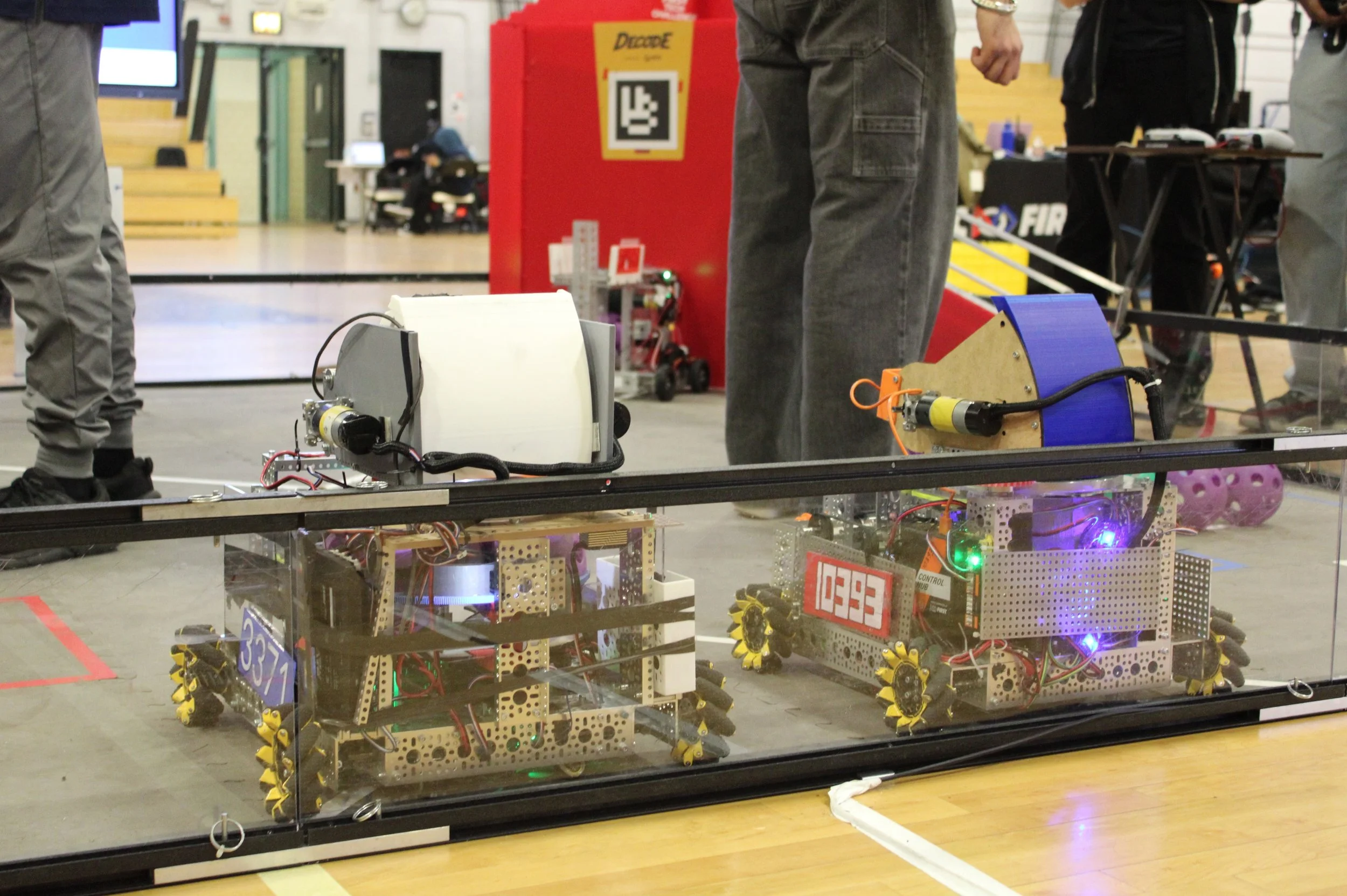
Pink Droyd and Bötley Crüe lined up against each other during qualifying matches. Photo: Miyuu Hanamatsu