
Tell Us Your Story: The Immigrant Experience
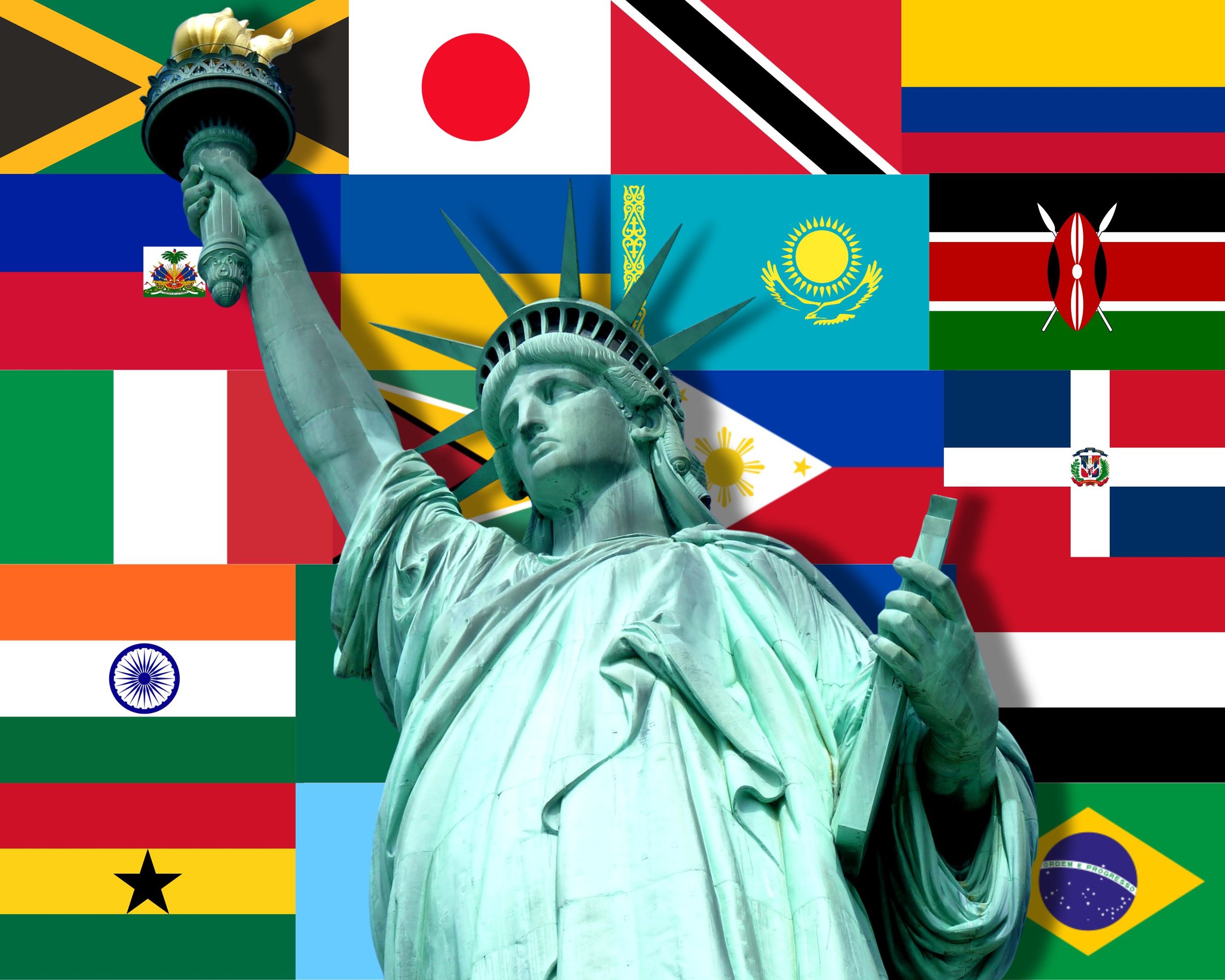
Approximately one in seven Americans was born in another country. Image: Anaya Mcleod
By AMELIA CRAWFORD
As of 2025, nearly 52 million immigrants call the United States home, each with their own story, their own experience. For many, the real journey doesn’t begin until after their arrival on U.S. soil. It begins with the weight of leaving behind the life they once knew and having to build a new one from scratch, having to learn who they are all over again.
One story opens in 2015, after an arrival from Samarkand, Uzbekistan. Senior Zarbonu Karshieva left home at seven years old with her parents and younger sister, looking for better opportunities in employment and education. Karshieva grew up in a rural part of Uzbekistan so it was “very different compared to a big city like New York,” she said.
Her family originally decided to stay for ten years and then return to Uzbekistan. However, they ultimately decided to stay permanently because they had adjusted to this new way of life and preferred it.
There’s lots to like about America, but things aren’t perfect. Karshieva, who is Muslim, wears the hijab, and said that while she hasn’t experienced a lot of Islamophobia in New York “because it’s diverse,” she is often bothered by the negative views of Muslims she encounters online.
Mr. Nermin Cecunjanin, a Midwood dean and social studies teacher, came from a small town in Bosnia and Herzegovina and, like Karshieva, was amazed by city life. In 1999, around the age of seven or eight, Mr. Cecunjanin, along with his mother, father, and three siblings, departed from Bosnia to steer clear of a war that had broken out between Kosovo and Serbia.
The first of his many memories of New York City was the skyscrapers. “I had never seen anything like that where I was from,” Mr. Cecunjanin said. “There aren’t buildings past the fifth or sixth floor [in Bosnia].”
Mr. Cecunjanin had to adjust to the fast pace of life in New York because in Bosnia, people have a much more “relaxed” attitude. “[New Yorkers are] always go, go, go,” he said. “Always going to work, always in a rush, always doing something.”
Although the city is restless, there is also so much to experience. New York is the most linguistically diverse city in the country. Mr. Cecunjanin likes that more than 70 languages are spoken at Midwood alone.
Education was also something new to Mr. Cecunjanin, as by the time he left Bosnia he had never attended a day of school. In the United States, children typically begin learning at five years old, so when he arrived, schools were eager to kickstart his learning.
“They wanted to throw me in the third grade,” said Mr. Cecunjanin. “My mom was like, ‘He doesn’t even know how to hold a pencil.’”
While Mr. Cecunjanin came here ready to learn, Ms. Susanna Sala, a Spanish teacher, came ready to teach. She left Spain in 2006 as part of a visiting teacher's program. “I just wanted to live a new experience,” she said. “I wasn’t planning to stay. In my mind I was only going to stay one, two, three years, and then I was going to go back home and continue teaching.”
Ms. Sala already knew some English, but at times there was still a learning curve. “When you’re learning a language, sometimes you might know how to say something but you don’t know if it’s appropriate or not,” she said. Once, Ms. Sala wanted to tell a student to be quiet and she accidentally used an offensive form of the phrase (in a respectful tone). The student had to explain to her that it was mean.
Social mannerisms also brought some challenges. Here, when seeing someone familiar, it’s typical to say “Hi, how are you?”
“I was like ‘Wow, everybody wants to know how you feel,’” Ms. Sala said. “But people didn’t really want to know how I felt, it was just a way to talk.”
Besides language differences, cultural traditions also offer new experiences. Junior Sofiia Serdiuk left Kherson, Ukraine at ten years old with her parents to be with her brother, who immigrated a year prior.
American holidays like Halloween and Thanksgiving were new for her. “It was really cool to see neighbors be so friendly on Halloween,” Serdiuk said. “It was actually amazing because people shared their kindness and traditions with everyone else, even if they were foreign.”
Similarly to others, Serdiuk faced language barriers, and her peers gave her a hard time for it when she was young, making fun of her accent.
After Mexico and India, the country with the most immigration to the U.S. is China; nearly 3 million first generation Chinese Americans currently live in the U.S. Xiaoen Zeng ‘27 left Canton, China in 2019 with her father and younger brother. Much of her family was already in the United States, so they followed.
“They thought the U.S. was a better place for us to live,” said Zeng. “There’s a better education system here compared to the one in China.” School there was grueling, she said, with schedules lasting from 6 a.m. to 5 p.m. every day. Homework was also intense, even for lower grades.
“When I was in China, I used to spend more than four hours on homework [each night] and I was only in fifth grade,” said Zeng. “So for me, America’s education system was like a safe place.”
There were downsides to the move, though. In China, Zeng’s family was able to own their own house and live comfortably, but in New York, it was expensive just to rent an apartment. To cope, her family stayed with relatives until they could find their own place.
Around Flatbush, you’ll find many Caribbean immigrants as well. Pauline Crawford, my grandmother, left the parish of Clarendon, Jamaica in 2002 with her husband and two children, following her eldest daughter, who had already been living in the states.
Crawford was happy to be leaving Jamaica with her family, which was all she needed. “I was excited for the experience,” she said. “I'd never been outside of my country before.”
Fitting in was a breeze, as Crawford considers herself someone who can blend in anywhere. She said, “When you go to Rome, you do like the Romans do.” She finds her life here to be quite enjoyable, though she misses Jamaica’s abundance of fresh fruit during the summer and being able to walk outside and pick a mango from a tree.
These stories exemplify how varied but also how similar each immigrant experience can be. Although our interviewees all came from different places, they each had to rebuild their homes and sense of belonging in a place that used to be unfamiliar. Their stories are a reminder that behind every statistic, there is another person also learning to call the United States home.
OTHER STORIES
By AYELEN FERNANDEZ
Kenicia Galloway, a junior at Clara Barton High School, grew up in Guyana, where heavy rains caused many floods. One left a lasting imprint on her when she was four years old.
“I was terrified of the possibility that I might drown, as my body was half the water’s height,” she said. “But my mom assured me that she wouldn’t let that happen as I held her hand tightly.”
Tonica Dear, her mother, had seen glimpses of American life through friends and family’s posts on social media. Dear decided it was time to move to America when Galloway was ten years old.
Stepping into the airport, Galloway felt uncertain about what the future held for her. Every turn she took was more unfamiliar than the previous, and her stomach began to turn into knots as she looked up at her mother, searching for reassurance.
“The signs, the hurried footsteps, even the voices made me feel so out of place,” Galloway said. “But I put my bravest face on, hoping my mother would be proud of me.”
Once Galloway arrived in America, she found herself settling into what she would learn to call her forever home. Her outgoing personality helped her create friendships. What once seemed a challenge she found herself afraid to overcome became exciting as she began to find her place in this new world.
“I never thought leaving behind the only place I knew as home would lead me to finding it all over again hundreds of miles away,” Galloway said.
Stephanie Chan ’27, a student from the vibrant city of Shanghai, China, navigated crowded streets, long hours of school and extracurricular activities, all while helping care for her younger sibling Luke.
Chan's parents decided to move to America when her father, a software engineer, was offered a position that would pay him triple his Chinese wage.
“It was so sudden that I didn’t even have time to say goodbye to my friends,” Chan said. “I remember the rush like it was yesterday, not knowing my life would change forever.”
Upon arriving, Chan found that the American school system, social expectations, and norms were different from what she had experienced in Shanghai. She began to find her footing as she started to join clubs and make new friends.
“Sometimes I miss the life I had in China,” Chan said. “But those thoughts are quickly erased when I am reminded of my friends, my school and the freedom I’m happily able to enjoy in America.”
By DANIELLA GANZBURG
A young girl arrived in the U.S. in 2019 from Kherson, Ukraine, with a bright future ahead. With big hopes, but even more fear, Sofiia Serdiuk ‘27 came to her new home with her family.
Serdiuk’s family was contemplating moving to America for a while due to the better job opportunities, so her brother came first on his own to see what it would be like. After much skepticism and worries, the entire family moved to New York to begin a new life. As eventful as life in a new place may sound, it always comes with hardships.
“I felt lost and sad at first because I didn’t speak English,” said Serdiuk, “and to make things worse, I got bullied in middle school for not speaking English, so I knew it would take me some time to adjust.”
Leaving old, close friends to move somewhere unknown was devastating, Serdiuk said, because there was no guarantee of finding the same connection with other people. However, Serdiuk also believes that this wasn’t a terrible thing for her because it taught her to talk to others and showed her other cultures.
The United States is one of the most diverse countries in the world. About 15% of the population is immigrants – approximately 50 million people, from almost every country in the world.
Wania Zahid ‘28 came here from Lahore, Pakistan when she was three.
“At first I was very confused,” she said. “I barely knew Urdu (a language spoken in Pakistan), and now I had to learn a whole new language.”
Zahid said she felt intimidated by the foreign land that she had settled in, and she had no idea what the future would hold. “When I first came home from the flight, I was terrified. There is a video of me turning away from everyone,” she said, laughing.
However, moving to America was one of the best things that happened to her, he said, because it gave her more potential to be successful, as there weren’t many opportunities for her family back in Pakistan.
Zahid is saddened, however, to be separated from her extended family. “I never got the chance to know a lot about them,” she said. “A ticket to Pakistan is hella expensive, and my family can’t afford to go there a lot, which is sad because things are happening and I’m missing out on them.”