
Explaining the Rise of the Manosphere
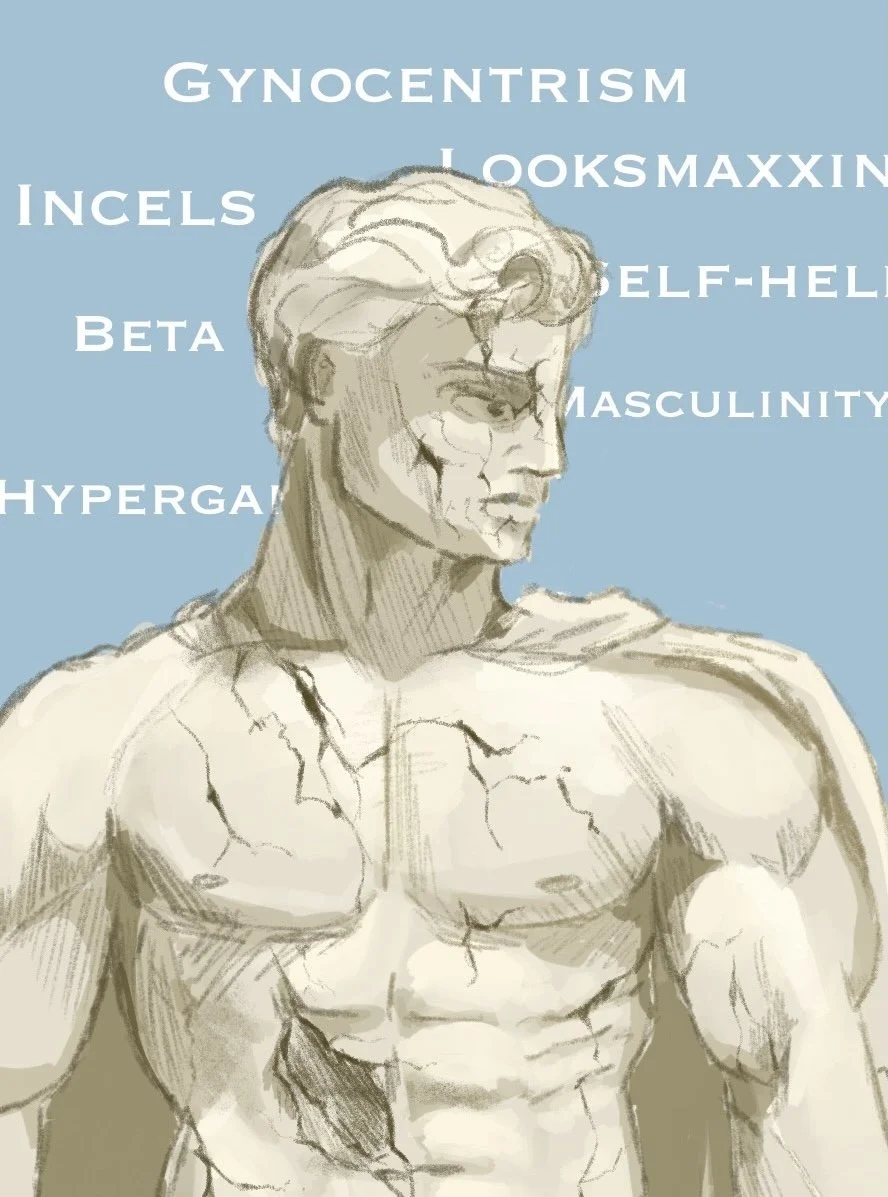
Art: Madeline Lee
By MUEEZ MANZOOR
Scrolling through social media, you tend to see everything under the sun. From “67” remixes, to cooking tutorials on making matcha-flavored Labubu-shaped chocolates, to motivational videos telling you to work and be better. When it comes to the latter, for male viewers, your stream can also branch off to a genre known as the “manosphere.”
The manosphere is best defined as a collection of websites, blogs, and online forums promoting various forms of masculinity, some of which feature an opposition to feminism and even descend into misogyny. Online, thousands of young men are being pitched a message: “You’re alone, you’ve been ignored, so take control by rejecting what society told you and rebuilding yourself as a ‘real man.’” Some of this is self-help, but it can also devolve into hatred under the guise of empowerment. This all points to a deeper issue, that young men are struggling to find their identity.
On one side are “bro-culture” podcasters like Joe Rogan or self-help gurus like Jordan Peterson. On the other end are “pick up artists” and “incel” (involuntarily celibate) communities that spread radical views, and people like Andrew Tate, whose extreme posts have gotten him banned from platforms. (Tate is also embroiled in criminal accusations of rape and human trafficking.) Together, these two ends shape a movement which reflects the growing crisis in how young men find identity online. But what exactly is the reason for its growth?
Fundamentally, the manosphere exists because men today feel lost. As gender roles have shifted, the culture has changed, and the phrase “toxic masculinity” has risen in usage, “there’s this sense that men don’t know what they’re supposed to be anymore,” says James Bloodworth, author of The Rise of the Manosphere. “That uncertainty leaves space for influencers to step in and define it for them.”
Genuinely, there are people who use the materials of the manosphere to improve upon themselves, wanting to work out, build discipline, and gain confidence. However, some of this material builds up a sense of frustration that society seemingly has cast young men aside, and turns things into a blame game, echoing the tropes that “men are under attack” and “women can’t be trusted.”
Studies are piling up reflecting the growing angst among boys and men. One by Lancaster University found that among 16-24 year-olds in the UK, 50% of male respondents agreed with the statement “feminism has gone too far and makes it harder for young men to succeed,” compared to 23% of female respondents.
Taveeshi Gupta, the senior director of research, evaluation, and learning at Equimundo, and the lead researcher for the State of American Men 2025, said that the organization’s latest report found that most men of all ages, but particularly young men (69%), agreed that “no one cares if men are okay.”
This isn’t all. A study conducted by the American Psychological Association found that “nearly one in ten men experience depression or anxiety, but less than half receive treatment. Even more alarming, men die by suicide four times more often than women.”
This fundamental lack of a support system for young men is key to understanding the explosion of the manosphere. As per The Guardian, “The idea of masculinity has been changing fast, and for many boys and young men, that change feels confusing… When video games, social media feeds, and podcasts tell you that masculinity equals strength, dominance, wealth, and women equal the reward, you start to believe your value is conditional.”
These influences may lead to men adopting rigid ideas of manhood, that being tough or dominant is the only valid path. These beliefs end up hurting relationships, both private and social. Some men may isolate themselves or turn to harmful coping strategies such as substance use rather than ask for help. This crisis of identity could lead to a generation of young men who feel misunderstood and who think of the world as being against them.
“Men are seen as powerful and expected to endure anything, including traumatic events,” said senior Luis Olvera. “We are seen as the people with privilege in most cultures, both eastern and western. As a result, men have not been seen with a lens of humanity, and in turn, the population can neglect their wellbeing.”
Junior Jonathan Li said, “People simply expect men to know what to do, and expressing our feelings or vulnerability is seen as unmanly in today's world.”
However, there is something we can do. The manosphere is not just a fringe phenomenon. It is a sign that men are just as vulnerable as women. Schools should encourage discussion on not just women’s issues, but also men’s empowerment, emotional needs, and sense of belonging. We should encourage healthy male peer groups and support networks.
As for parents, they should create spaces where boys are safe to admit confusion, and model that strength doesn’t mean suppressing feelings.
Finally, for us students, we should notice when influencers' messages push hatred. Letting our world views be shaped by social media, which is fundamentally designed to keep us engaged no matter what, does not seem healthy in any way possible.