
What's Really Behind NYC's Housing Shortage, and What Can Be Done About It?
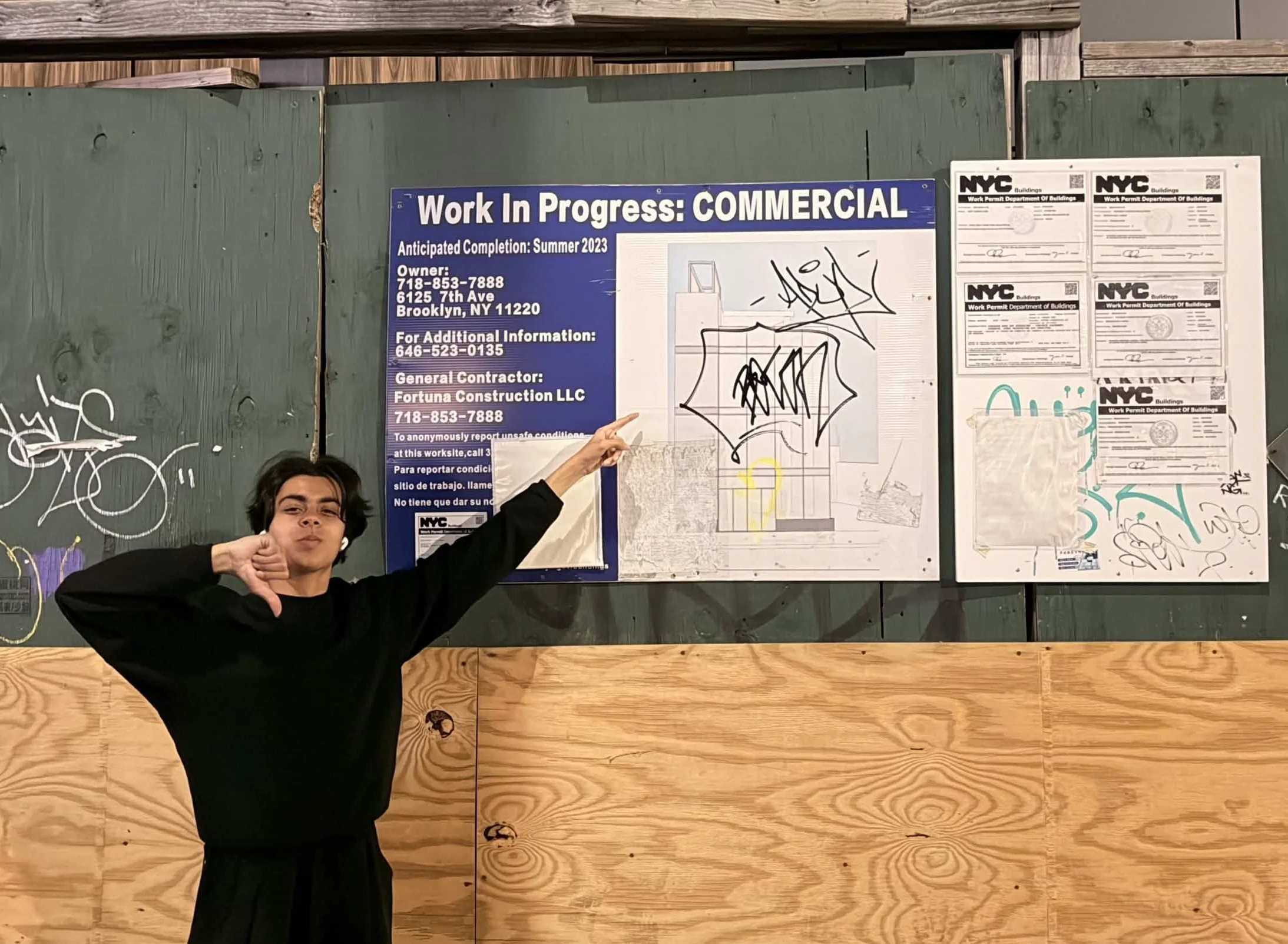
This commercial building in Brooklyn has not been completed in nearly three years. Photo: Mueez Manzoor
By MUEEZ MANZOOR
with a contribution by Daniella Ganzburg
Ah, the Big Apple, a city where for generations, as enshrined upon the Statue of Liberty, the weak and poor have come to build a better life, which we know as the American Dream. However, what is a dream, if the means to achieve it are impossible?
For New Yorkers, a question has long lingered: How can anyone afford housing in this city? NYC has always been expensive, but post-Covid, rent and home ownership costs have increased even more dramatically than usual.
Unfortunately, wages haven’t risen proportionally. According to Zillow, rent for a one bedroom apartment in Midwood ranges from $1,800-$3,000 a month. For more affluent neighborhoods such as DUMBO or Williamsburg, it balloons to an average of $4,000. For a city with a median household income of about $80,000 a year, it seems like a death trap if nearly half your money goes to rent.
Mr. Cameron Jahn, a chemistry teacher, has lived here for 23 years. “Renting in the past wasn’t bad,” he said. “I lived in Prospect Heights for a while. But now? It seems like a fever dream.” The truth is that at a fundamental level, the system is working against us.
There are three levels to this problem: high building costs, strict zoning laws, and extensive requirements for permits and lawyers.
First of all, NYC is the most expensive city in the world to build in, averaging $534 dollars per square foot in 2026, according to Turner & Townsend’s International Construction Market Survey and multi-year tracking by firms like Arcadis and United BIM.
Why? Compared to other metropolises, NYC has a lot of bureaucracy, red tape, and rules about how much you have to pay construction workers – often a higher-than-market rate called “the prevailing wage.”
NYC’s unions also often specify that a job you could pay one handyman to do must be split into a multi-person job, with some workers mandated to only stand by (e.g., holding a fence or watching tools), as per The New York Times’s investigation about the MTA, “The Most Expensive Mile of Subway Track on Earth.”
Adding on to that, NYC’s Labor Law 240 states that if a worker falls from a height, the owner of the building can be held responsible, even if the recklessness of the worker is to blame. That’s one reason you see scaffolding almost everywhere in the city. As a result, insurance companies charge developers exorbitant prices, requiring payments far above those of other states.
Problem two is the policy of zoning (rules the city sets about what you can build where). When I visited Japan with Midwood earlier this spring, I saw a sea of apartment buildings, even full-on multi-purpose complexes, filled with apartments, shopping malls, and convenience stores in the most remote regions, and wondered, why don’t we do that?
In NYC, we often classify regions with strictly designated types of housing that developers can build. In Brooklyn, such as near Midwood, that zoning is often “low-density,” meaning that only single family homes or small buildings are allowed. This prevents developers from cashing in on areas that could reap massive returns on investment, due to the city's rulebook.
On top of that, zoning codes require specific land use lawyers in order to negotiate with the city for permits. Besides the exorbitant prices lawyers often cost developers, the time needed to get such a permit can tick on for months, even years. (Ever see construction sites that always seem the same, years later?) During that time, the developer is also paying interest every month on the loan they took out to buy the land. That cost isn’t simply absorbed, it's eventually factored into your monthly rent.
With all these factors in mind, the only profitable buildings to develop end up being luxury towers. Just hitch a train to Dekalb Ave in Downtown Brooklyn and look around at the buildings that have gone up in the past 20 years.
You may ask yourself if all hope is lost, but real efforts are being made to fight back. Mayor Zohran Mamdani, who leans more to the left politically than the traditional Democratic establishment, has promoted policies such as rent freezes and social housing to address the issue.
Currently, about one million apartments in the city are rent-stabilized, meaning that landlords cannot charge whatever they want once a lease ends. Instead, a nine-member group called the Rent Guidelines Board (RGB) votes every summer on the maximum percentage a landlord can increase the rent (usually between 2% and 5%), which is usually far below the market rate.
Mamdani has proposed a rent freeze (on only these rent-stabilized apartments), forcing that increase down to 0%. This could give anyone who is lucky enough to have a rent-controlled apartment some sense of security.
But if you, like most New Yorkers, live in a non rent-stabilized apartment, your landlord can legally raise your rent by any amount. To stop this, Mamdani is also pursuing universal rent control, which would apply to every apartment in the city, capping annual increases at either 3% or 1.5 times the inflation rate, whichever is lower. If a landlord wanted to raise the rent higher than the cap, they would have to go to housing court and prove to a judge that their operating costs justify the hike (e.g., they’re paying for a major roof repair).
Some left-leaning publications like The New York Times, The Nation, and Jacobin have praised Mamdani’s ideas, arguing that price caps are the only way families can actually keep a roof over their heads. It’s also true that by capping rents, the city might save millions of dollars that would be spent managing homelessness.
However, conservative outlets such as the American Enterprise Institute, City Journal, and The Wall Street Journal argue that rent control is essentially a slow-motion wrecking ball for a city's infrastructure.
They point out that NYC relies heavily on property taxes to fund the MTA, public schools, the NYPD, sanitation, and more. Property taxes are calculated based on how much a building is worth. If Mamdani forces multi-year rent freezes, the market value of those buildings will plummet and the city will collect significantly less tax revenue. Therefore, a policy designed to help regular families could end up starving public schools and transit systems of the funding they need to operate.
So let's look at examples where Mamdani’s policies have been tried before.
In 2020, Berlin implemented the Mietendeckel, a radical citywide rent freeze that capped prices for 1.5 million apartments at 2014 levels. This is verbatim what Mamdani has called for. And sadly, it was an economic catastrophe. Within a year, the number of newly listed rentals plummeted by over 50%. Because landlords could no longer make a profit renting, they immediately tried to sell their apartments as condos or even chose to keep them vacant.
While lucky tenants who already had an apartment saved money, young people, immigrants, and newcomers found it physically impossible to find a place to live. The German Constitutional Court eventually struck the law down as unconstitutional.
NYC also attempted something similar in the 1970s.
At the time, the U.S. economy had hit a wall of hyper-inflation. The cost of plumbing, roofing, heating oil, and construction doubled. However, the Bronx was still under strict post-WWII rent control laws. The city refused to let landlords raise rents to match inflation, in essence freezing a landlord's income but not their fundamental expenses.
When a building costs more to operate than it brings in, it becomes a financial liability. Landlords in the Bronx were losing money every month, and they couldn't sell their buildings because nobody wanted a business that was guaranteed to lose money. So they walked away and stopped following up on repairs.
Mayor Mamdani does not have to fall into the traps of the past. To truly fulfill his vision of housing as a human right, his administration should pivot from relying on rent freezes toward a policy similar to other cities that cut red tape for developers. Sure, rent freezes would give working families breathing room, but they aren’t a final solution.
The core issue is a shortage of housing. In the Atlantic article “High-End Construction Really Does Help Everyone,” Henry Grabar argues that the solution starts with simply building more housing at every level. He explains that “more housing supply of all kinds,” even luxury, “leads to lower prices in general terms.” As wealthier renters move into new buildings, older apartments become available and more affordable, increasing supply and reducing pressure across the market.
Additionally, the Wall Street Journal article “Why Developers in NYC are Suddenly Obsessed with the Number 99” shows how zoning rules are unintentionally slowing construction. Developers often limit buildings to 99 units to avoid running into destructive regulations that kick in afterward, such as having to pay higher wages and deal with other expensive and time-consuming requirements. By staying under the limit, they can save money, build fast, and make a profit. The fact that there are now so many 99-unit projects shows that developers have the will to build when the city makes it easier for them.
Instead of capping prices on a broken market, Mamdani can solve this crisis by eliminating rules such as restrictive local zoning laws so more middle-market housing can be built. When developers don't have to pay millions in extra costs, they can afford to build regular apartments without the luxury tag. This has worked in Austin, Texas, where developers have built tons of housing and residents are paying night-and-day level differences in comparison to NYC.
Mamdani has also pledged to commit $100 billion over 10 years to construct 200,000 units of government-owned, permanently affordable housing, built directly on city-owned land. This is a good idea. Slashed regulations can also feed into Mamdani’s social housing goals as the city builds these units for families who make typical wages.
So there’s reason to be hopeful. Many cities don’t operate this way, and we don’t have to, either. But until the uncertainty of this monumental issue is dealt with, one can only wonder: Will the Big Apple act on her age-old promise, or let the people who built her be kicked out of their own collective creation?