
Worms, Fossils, and More: Annex Display Cases Spark Students' Curiosity
Composting worms and nuclear models are among the displays on the second floor. Photo: Xiaoen Zeng
By XIAOEN ZENG
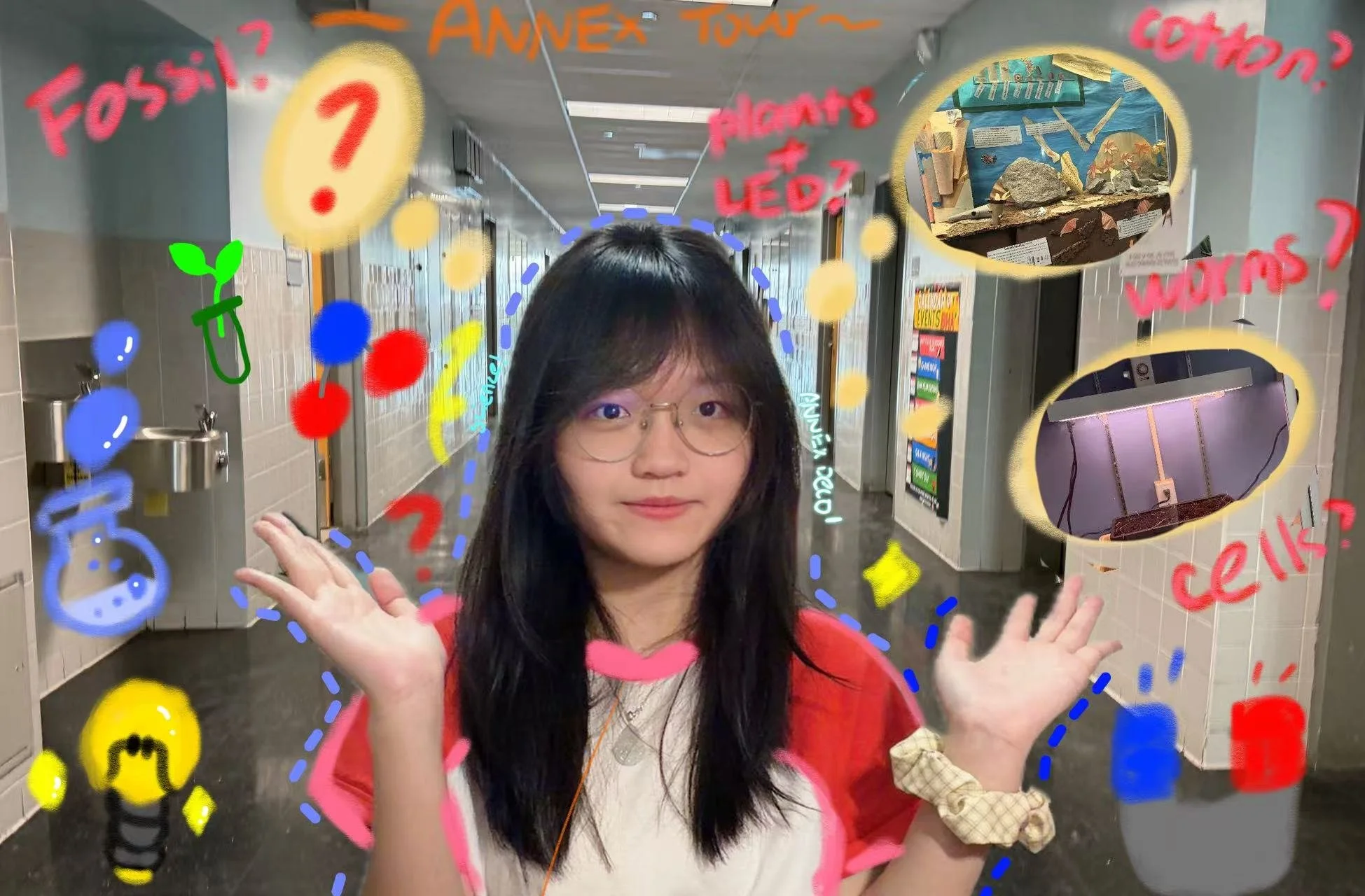
As you walk through the annex halls, you see display boxes with worms, fossils, and even growing plants. Have you ever wondered: What are these? Why are they there? Science is alive in this building!
The second floor holds the department of biological sciences, along with a giant container of rotten bread and fruits. When you bend down and take a closer look, you’ll see worms slowly moving their bodies across the bread.
Don’t be grossed out! These worms are actually students’ teachers, helping demonstrate the composting process. A worm's body is about 90 percent water, so when it dies, it shrivels up and becomes part of the compost rather quickly, which helps make nutrients available to plants. After 3-5 months, it will be the time to remove the finished compost from the bin.
Mr. Tovia Rosenfeld, the assistant principal of biological science, who is also in charge of the decorations, said, “In regular biology class we couldn’t do these things because we have a curriculum to follow and students need to take the Regents at the end of the year, but we are always trying to do something interesting.”
If you create a favorable environment for your worms, they will work tirelessly to eat your “trash,” and you will notice less and less bedding and more and more compost in your bin.
Mr. Rosenfeld is also growing these worms to feed the turtle that lives in room A219, so say hi when you have a chance. And if you have any leftover fruits and vegetables, please bring them to A200; they will be put into the bin for good use.
Another interesting display on the second floor began in February, when students planted wheat and cotton seed under LED lights, which is actually an effective way to make them grow.
The display cases on the third floor are mainly showcases of our science teachers’ creative lessons. For example, near the chemistry lab room, you’ll find students’ nuclear models, with a sponge ball representing the nucleus and its protons, pipe cleaners to indicate the movement of the electrons, and small beans to indicate the electrons.
There’s also a display of fossils from the natural disaster class. Mr. Greg Salwen brought them to class and split them after school. One is of a crinoid, a marine invertebrate also known as a sea lily. It looks like a plant but is an animal in disguise, and it covers the bottoms of oceans in shallow waters.
Closer to the bridge, you’ll find old equipment such as scales that were used by teachers in the main building before the annex was built in 2008. The tools and models “are super pretty,” Wing Yau Zhou ’27 said, “and definitely a highlight of the annex.”
Ms. Jenessa Kornaker, the assistant principal of physical science, said, “We decided to keep [the old tools] not just as a way to honor everyone who has come before us, but also because a part of knowing where we’re going in the future comes from knowing our history.”
The hallway displays “spark students’ interest,” she said, “especially with the fossil one that was set up by the natural disaster classes. I found that a lot of students were looking at them and trying to figure out what they were looking at, which is kind of cool!”
There’s plenty more to see in the annex on all three floors, so stop by when you have a chance and make sure to look around, stay curious, and explore.