
Science Fair Puts Chemistry, Engineering, and Physics Experiments to the Test
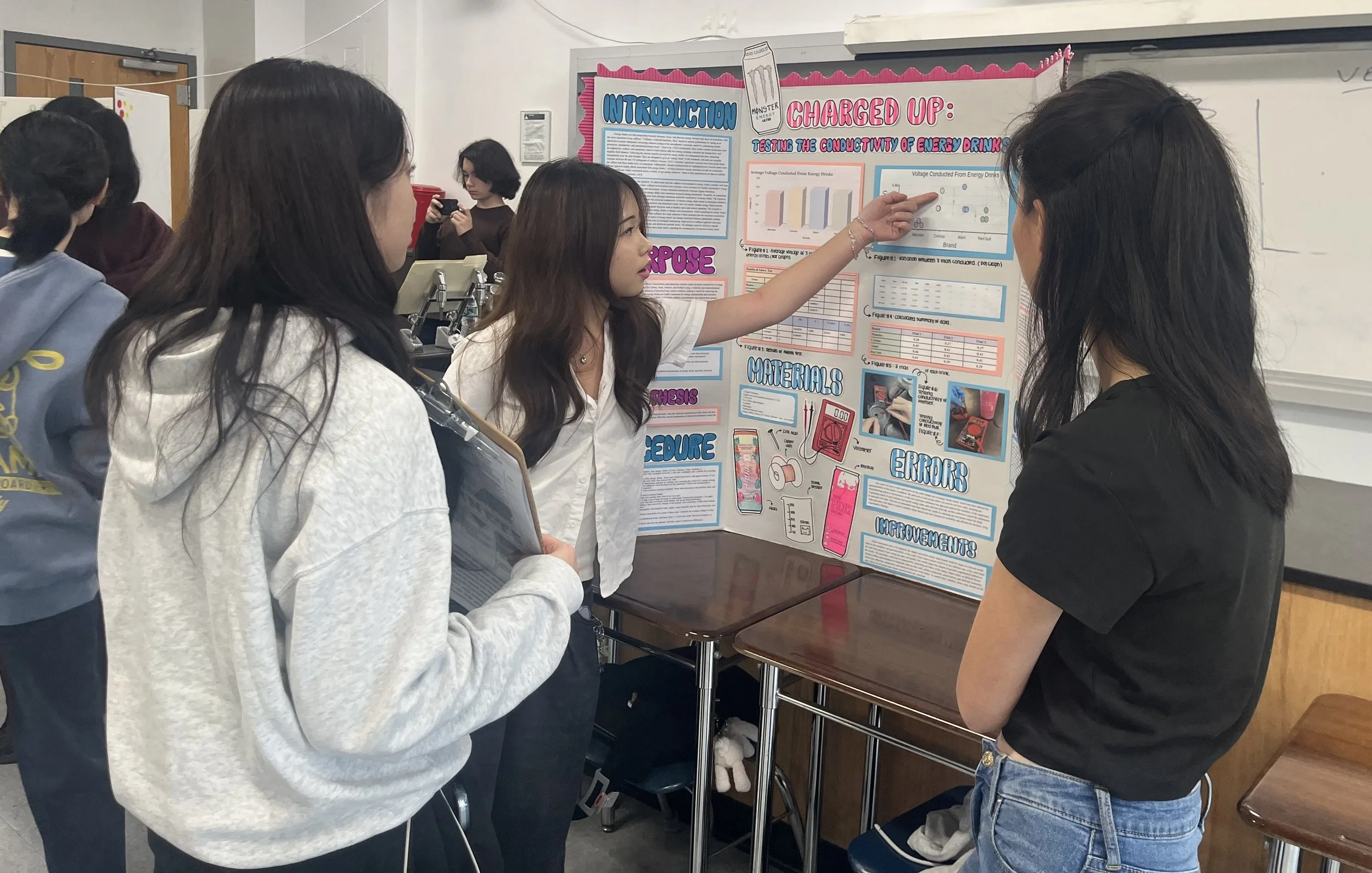
Xiao Ying Ruan and Angela Wu present their experiment on the conductivity of energy drinks. Photo: Angel Wu
By HUI SHAN ZHANG and LILY DENG
On May 21, eager sophomores filled the annex, resolute in presenting to alumni and upperclassmen their Science Fair projects ranging from chemistry to engineering to physics. After months of learning and experimenting, they were putting their skills to the test.
“Science Fair is an event where students showcase what they’ve learned over the entire span of sophomore research,” said research teacher Ms. Avanel Cunningham. “It's a class where you have to use your critical thinking skills to figure out information. You use math skills, you use reading skills, you use research skills. They all intertwine and eventually you come up with a sort of conclusion.”
First place went to Mariami Sadaghashvili and the team of Irene Qiu and David Chen. Second place went to Ana Mamukashvili and Luca Plot-Loeb individually, and to the team of Earus Chi and Mandy Mai. Third place went to Hania Sarfaraz and the team of Chrysantha Zhong and Hailey Cheung. Three individuals and four teams received honorable mentions.
Qiu and Chen created a glasses accessory that functions as a teleprompter. When worn, the glasses flash text on the display.
“We thought it’d be interesting to see how using a heads-up display (HUD) can improve our presentation abilities rather than just relying on memorization or paper notes,” said Chen.
Inspired by Zack Freedman’s Optigon, the glasses were tested by six students with various backgrounds and speaking skills, each reading a 150-word script. Three used the HUD first, then paper notes and memorization; the other three did the same but in reverse order. The students were recorded and rated by peers based on audience engagement and verbal fluency.
The project’s presenters wanted to help with fear of public speaking. “It isn’t just something you have to learn to ‘get over,’ but a situational form of anxiety that is triggered when people are made to speak to a live audience,” said Chen.
Zhong and Cheung analyzed how quickly oral medicine is absorbed by the human body and weighed the pros and cons of three capsule materials: pullulan, HPMC, and gelatin.
“I remember Hailey and I stressing out over whether or not our topic would be too common, too vague, or unattainable,” said Zhong. “We first stumbled upon this idea when I was researching NYU labs; the Pinkerton Lab was the main inspiration.”
“It was difficult to keep track of data and most importantly, conduct the experiment itself,” said Zhong. They failed the experiment multiple times and at one point were running out of acidic solution. “Figuring out how to calculate specific formulas and actually leverage that information was tricky,” she added.
Prior to the presentation, Zhong said, “we could mess up our lines at any given moment.” She rehearsed with Cheung and friends any time they could. “I expected to panic at moments and forget a few lines, but it turned out better than I expected,” she said.
Sarfaraz researched magnetohydrodynamics. She created an electrical circuit using saltwater as an electrolyte and two metal plates connected to batteries with alligator clips. Magnets in the circuit then pushed the water. She used food coloring as a tracer to track the water's movement from start to finish.
A struggle she faced was finding a clear plastic container to act as a channel to pour the water and build the circuit in. In the end, she found a clear container from her mom. “It was so perfect for my metal plates, even when I glued it down with E6000 [a multi-purpose adhesive],” said Sarfaraz. “It actually worked, and when I tested it with the water, the electrolyte, it worked very well for me to see the food coloring or the tracer move through the short line in the finish line.”
“It took me around five trials to get it absolutely right and working,” she said. “I didn't want to exaggerate my data because this was something I was genuinely interested in. It was stressful!” She realized there were more conclusions she could have made, so two days before presentations, she altered her conclusion and analysis. “I had to make my board the day of, and I remember I only slept an hour or two each night because I had to balance that on top of my normal work,” said Sarfaraz.
Ms. Cunningham said her favorite part of the fair was seeing students explain their projects. “I think if you're in medical science, there's no doubt that research should be your first option,” she said. “There's a level of independence with these projects you can execute on your own.”
“Sometimes I'm just like, these kids are geniuses,” she added. “It makes me feel like the future of science and research and whatever they go into is in the right hands.”
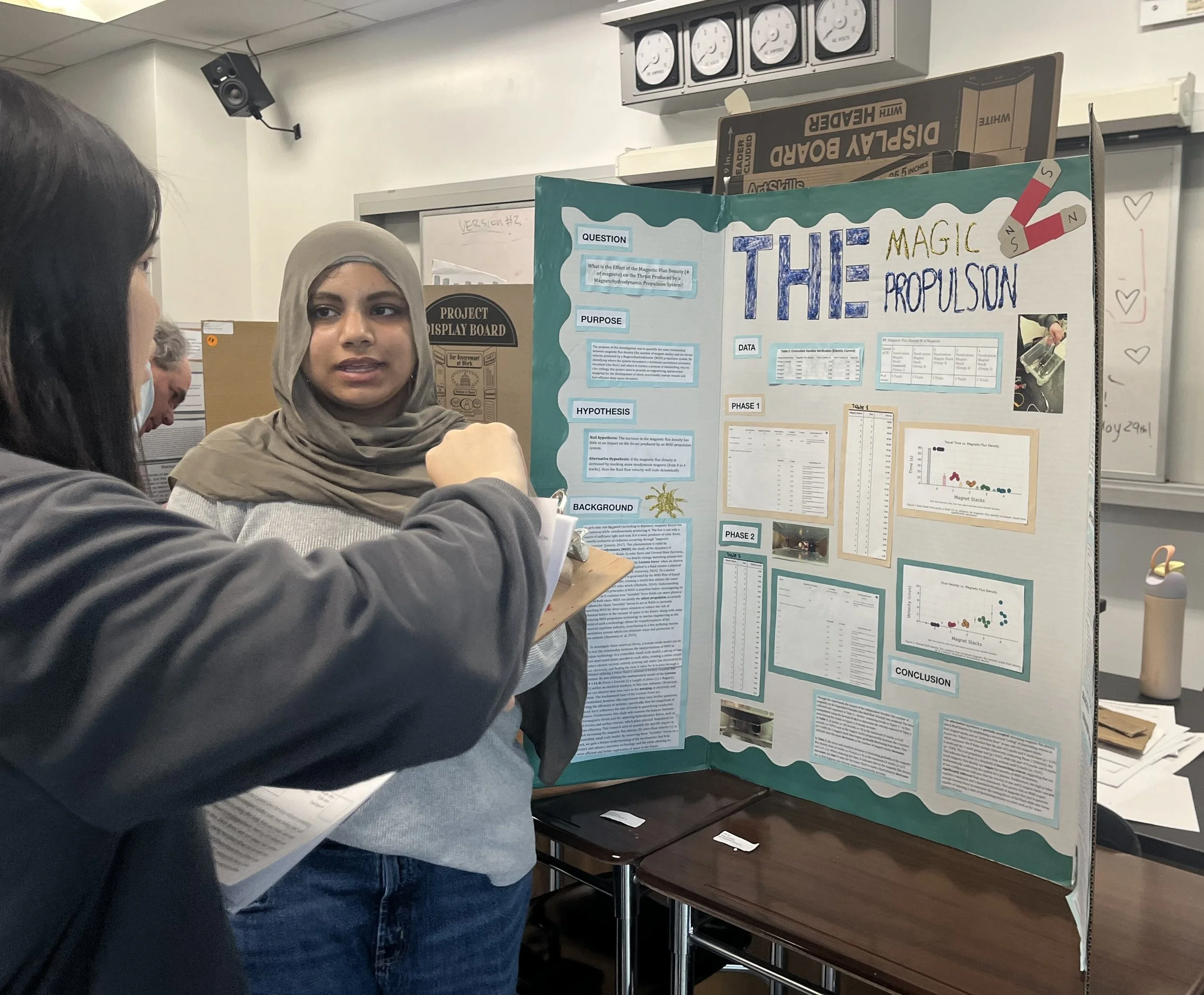
Hania Sarfaraz presents her research on magnetohydrodynamics. Photo: Angel Wu
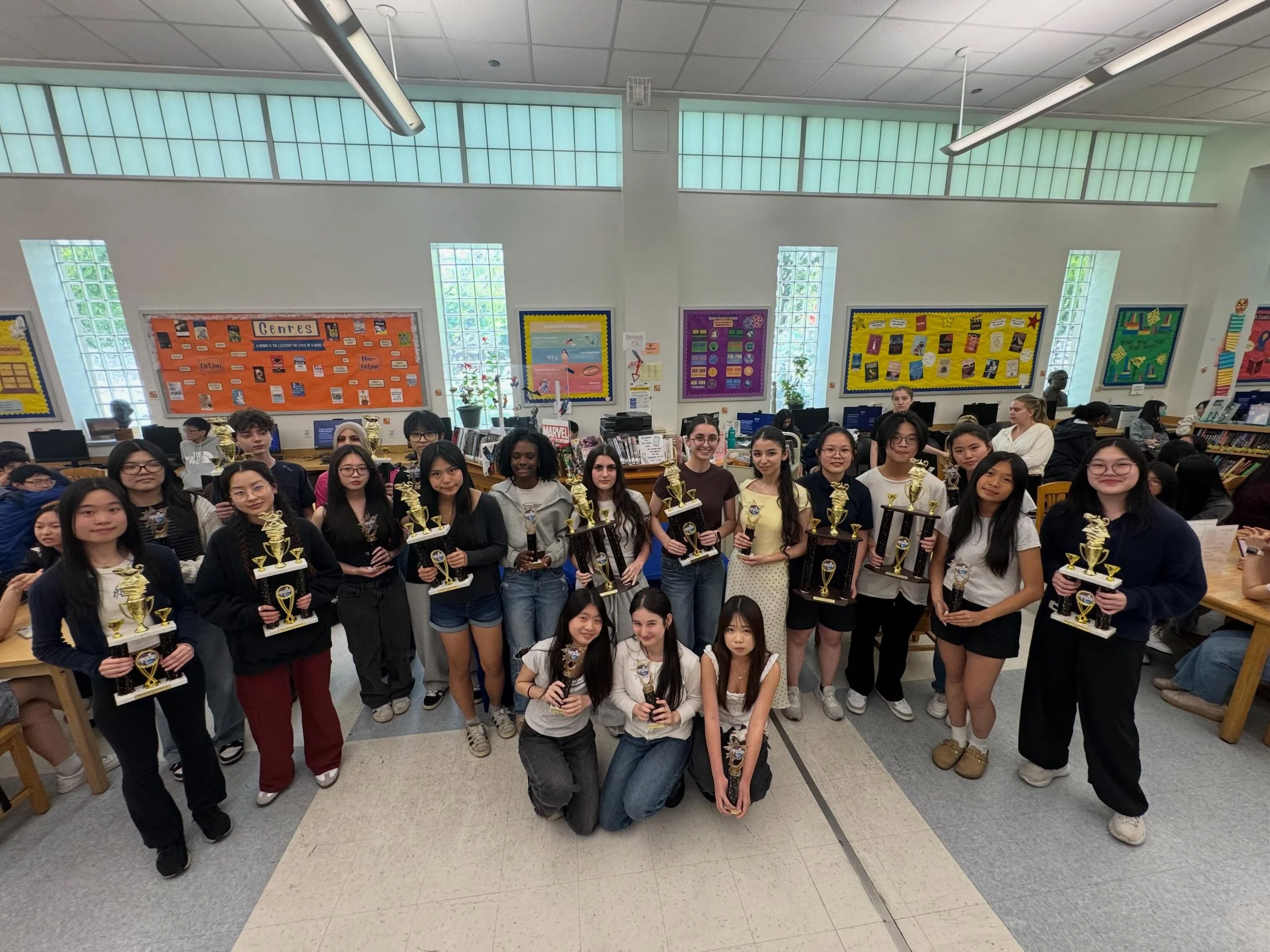
The 2026 Science Research Fair winners and honorable mentions pose with their awards. Photo: Midwood Science