
The Decline in Youth Literacy Is an Emergency
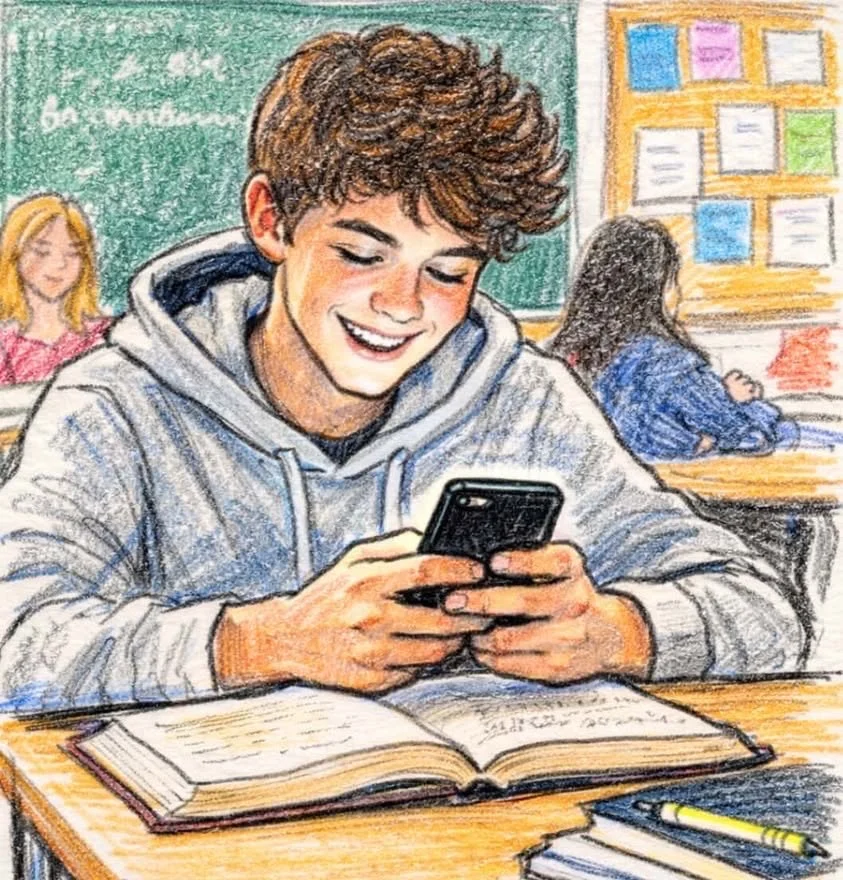
Books have a hard time competing for teens’ attention in the era of social media. Art: Yadira Rivera
By ERISA MANI with AYELEN FERNANDEZ
You get a ping from your phone, look over, and realize your friend texted you. But when you read through what they sent, you’re overwhelmed by sentences that don’t make sense.
Uses of “to” instead of “too” or “there” instead of “they’re” are just some of the symptoms of a decline in literacy, the inability to make sense of complex and adult-level texts.
Reading deficits in America extend to all age groups. Overall, more than 54% of adults between the ages of 16 and 74 lack proficiency in literacy, according to the Barbara Bush Foundation. Thirty percent of American adults read at a level that you would expect from a 10-year-old child.
However, trends among the youth are particularly concerning. Tests show that the percentage of young adults between the ages of 16 and 24 who score in the lowest, barely basic literacy level increased from 16% in 2017 to 25% in 2023.
This is likely connected to how teens decide to spend their free time. Fewer than 20% of U.S. teens read a book, magazine, or newspaper daily for pleasure, while more than 80% use social media every day, according to the American Psychological Association.
“It’s pretty wild to me how drastically numbers have dropped considering how more widely accessible books are to the public now,” Eder Ramos ‘27 said.
Senior Aziza Ziyadulloeva said, “People don’t have much interest in reading [these days] because they’d rather get something summarized or are just distracted by social media. Also, the school system plays a role because I feel like we’re given shorter readings since teachers know students wouldn’t read the literature if it was long.”
An EdWeek Research Center survey backs up her suspicion: Out of 300 third to eighth grade educators polled, only 17% said they primarily taught whole texts.
“It often feels as if we are being rushed into a story without being led through it,” said Jackqueline Cruz ‘27.
Ms. Cynthia Ly, a biology teacher, has witnessed first hand the impact of cell phones on students’ ability to engage with rigorous texts. “Technology has reshaped students' reading habits in ways that often slow down deep reading and comprehension rather than speeding it up,” she said. “Constant exposure to short-form content like texts, notifications, headlines, captions, and videos has trained many students to skim rather than read carefully.”
Twenty percent of Midwood students watch TikTok at least five hours a day, and 48% agreed that they had a hard time staying focused when they read, according to a 2024 survey by the Argus.
Sophomore Mandy Mai spends five hours a day on TikTok. “Short videos tend to shorten my attention span, and I often skip videos longer than 15 seconds because a whole minute now seems too long,“ she said.
“I believe that this reward cycle of instant gratification is a severe issue,” junior Asad Imtiaz said. “That’s almost 1/4th of the day gone looking at a screen and learning absolutely nothing.”
Much more than T.V. and video games, our cellphones demand our entire lives. They are intended to be hyper-addictive, feeding users a steady diet of useless notifications, inane short-form videos, and social media rage bait. A study by Fluid Focus found that on average, modern students are destined to spend 25 years of their waking lives scrolling on a screen, based on their current averages.
Okay, so cell phones are addictive and TikTok is bad for you. But as long as kids know the basics of reading, that should be enough, right? So what’s the big deal?
“Literacy is not simply knowing how to read, it's a continuous mastery of language,” said Mr. Jimmy Liang, an English teacher at Midwood. “Our literacy level needs to keep developing so that it doesn't become a barrier that excludes us from spaces of opportunity.”
Poor reading proficiency takes a significant toll on employment and the economy. The National Council for Adult Learning estimates $225 billion in annual losses due to nonproductivity in the workforce, crime, and loss of tax revenue because of unemployment tied to low literacy. According to the National Institute of Literacy, 43% of adults with the lowest literacy rates live in poverty, and 61% of low income families have no children’s books in the home.
Besides the economic cost, when people can’t read at a high level, they lose the ability to make sense of the world. We are moving quickly towards a future where information is shared and processed through spoken words and images, not text. As smartphones rob us of nuanced reading, our political discourse is collapsing into hostility and tribalism. How will we be able to comprehend our political leaders, critique them, understand our society’s past, and possibly change its future?
There is a lot that people can do to prevent a reversion to preliterate times. First, long form reading and writing should be encouraged at all grade levels by schools, and extra reading classes and vocabulary instruction should be implemented for kids who are behind. Second, parents should prioritize reading at home, as children who are regularly read to develop stronger vocabulary and comprehension skills. Third, teens need to commit themselves to reading more, as literacy is a skill you need to keep building throughout your life.
It’s time to rediscover the value of literacy, as it encourages profound knowledge, logical debate, and critical thinking. We might actually revert back to caveman times if this crisis isn’t addressed soon. Okay, me go read now.