
Cell Phone Ban Provokes Range of Reactions

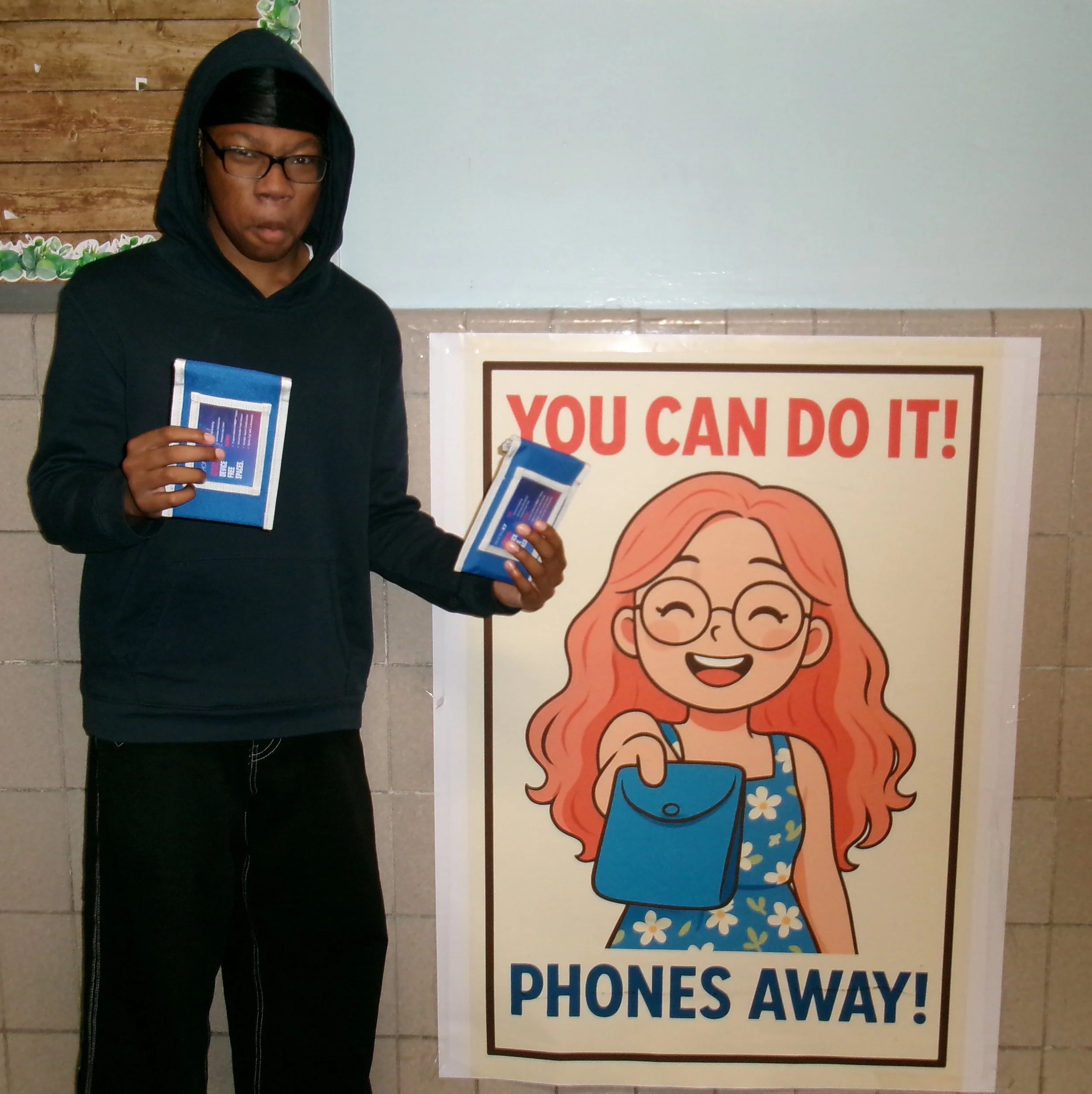
Angel Garcia Barrera ‘28 and Andrew Angel ‘29 pose next to one of Midwood’s reminder posters with their cell phone pouches. Photo: Dilan Below
By SHANZEH FAHID
A new school-wide policy banning internet-connected devices such as cell phones and laptops from 7:00 a.m. to 3:30 p.m. took effect at Midwood on the first day of the fall term, prompting a range of reactions from students and staff. The change, which requires students to keep their devices completely out of sight for the entire school day, including lunch and free periods, is a result of the New York State Distraction-Free Schools Law.
The state law mandates a "bell-to-bell" restriction on all personal "internet-enabled devices." This legislative push has been heavily influenced by the research of social psychologist Jonathan Haidt, whose book, The Anxious Generation, links the sharp rise in teen anxiety and depression to the widespread adoption of smartphones and social media.
"It's a state law that cell phones are not allowed to be used in school," said Mr. Richard Franzese, the assistant principal of safety and security. "My job is to enforce the rules, not create them." He did note, however, that there are exceptions to the rule for students with documented health issues, such as those with diabetes who need to check their blood sugar levels.
At Midwood, the administration opted against using lockable Yondr pouches, which many other schools have invested in. Anson Wu, a senior at Leon M. Goldstein High School, which uses the Yondr pouch, explained that students there lock their phones in pouches at the start of the day and have to get them unlocked by a staff member before leaving. He noted that while it made students "a lot more social," he felt the limitations were "too harsh."
Mr. Franzese said the main concern for Midwood was that using Yondr pouches would "create a slow down to exit," making dismissal too inefficient.
Mr. Daniel Krieger, an AP Government teacher, said the change was necessary and overdue. "It was a long time coming because too many students were becoming distracted," Mr. Kreiger said. "Since it's been implemented, I’ve noticed more people are focused and teachers are able to accomplish more with less distractions." His primary concern, however, was the ban on personal computers. "One of my major concerns was about the no laptop policy," he explained. "I found most students used their personal laptops for education purposes. I thought it'd just be phones."
"The new policy made using my personal laptop a privilege,” said senior Sofia Ni. “I miss being able to use my computer to take notes.”
Senior Aminah Clinton said, "I do not believe phones and laptops should be treated under the same policy. Why would a necessary tool be restricted under a policy created for an entirely different device?" Clinton said the policy has affected her ability to complete work during school hours due to "laggy" and "dysfunctional" school Chromebooks.
Senior Patricia Fortin agreed. "It’s a hassle to use school Chromebooks due to terrible internet connection and constant updates,” she said.
One criticism of the often-used Yondr pouches is the concern over safety, which many students at Midwood expressed. If there were ever an emergency, the pouch would need to be unlocked for a student to contact their parents or call for help. However, Midwood’s velcro faraday pouches avoid this risk by giving students the ability to access their device in a rare or extreme circumstance.
Still, being unable to casually contact a family member during the school day remains an issue for some. "I often have medical issues where I need to leave the building, and I’d contact my mom to do so," senior Najif Ahamed said. "It used to bring me comfort to text her."
The state law’s extension into non-instructional time drew further criticism from students. "During free periods, I think phones and laptops should be allowed," said sophomore Khadijetou Gueye. "[The full-day ban] is a bit excessive and unnecessary."
Ahamed called the ban during lunch and free periods "ridiculous," and senior Preston Harris explained that boredom and loneliness can set in during those times.
Supporters of the ban reason that this phoneless free time encourages more face-to-face interaction and socialization, something many students have lost in recent years. Haidt’s research also shows that long breaks from social media have a positive effect on teens’ mental health.
The ban’s proponents also argue that these free periods can be used to complete class readings or homework. However, many teachers’ homework assignments now require an internet-connected device.
"Laptops shouldn’t be banned during free periods because students could use them to complete their homework so they don’t have to do it at home," said senior Marve Ford.
The ban has also impacted after-school activities. Even though many upperclassmen finish their classes as early as 1:00 p.m., they aren’t allowed to use their devices until the official school day is over. "As a member of SING!, I feel it's very important as we need our phones to record and play music as electronics have become essential for practice," said senior Erica Li.
While many students report increased stress because of the ban, some have found a silver lining. "I definitely am more in tune now when my teachers are talking," said senior Alanna Lalman.
Senior Jessica Alderete agreed that she has been able to focus more on her classwork. "I have noticed some changes," she said. "People started talking more to each other, which is a really good thing."
Still, students were largely critical of the state law’s disregard for their individual circumstances. "It’s common that the context is ignored and adults often unfairly move straight to punishment without compassion or empathy for the student or the situation," Harris said.
Even during free periods, personal internet-connected devices are not allowed. Photo: Dilan Below